

With its formal registration complete, its manifesto released, and its inclusion in the ECI’s official list of RUPPs, the PRP has signalled its intent to be a serious contender in the 2027 Manipur Assembly election, positioning itself as a homegrown alternative built on candidate vetting, financial transparency, and accountability to the electorate.
TFM Report
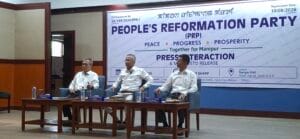
A new political outfit, the People’s Reformation Party (PRP), announced its launch on Thursday (September 24) at a press interaction held at Sangai Hall, Hotel Imphal, , with its leadership outlining a platform centered on candidate vetting, financial transparency, and a distinct local identity ahead of the 2027 Manipur Assembly election.
Addressing the media, party President Andy Mangsatabam opened with a critique of the state’s political establishment, stating that Manipur’s lawmakers have failed to resolve the ongoing crisis in the state. He argued that Manipur needs a genuinely local party to find political solution, distinguishing the PRP from parties governed by a “high command” system based outside of Manipur state—a reference to national and other regional parties whose decision-making is centralized elsewhere.
Party Structure and Electoral Strategy
Mangsatabam noted that the PRP’s registration process began in 2024, including a hearing in Delhi. The party intends to field 40 candidates out of 60 in the 2027 Assembly election. He stressed that the party would contest without money power, operating within the roughly Rs 28 lakh per-candidate expenditure ceiling permitted by the Election Commission (ECI). This was framed as part of a broader commitment to transparent political financing detailed in the party’s press handout.
A recurring theme was the PRP’s promise to select candidates through a due diligence and suitability process. This means PRP will go through a thorough research, verification, and evaluation of any intending candidate wishing to contest poll with the party’s ticket. The leadership invited the public to scrutinize office-bearers’ and candidates’ backgrounds, credentials, integrity, and financial disclosures rather than simply accepting the party’s claims. Mangsatabam said membership would remain open, but candidature would be selective. The party also spoke of reaching Manipur’s youth and its silent population through social media platforms, positioning itself as forward-looking and generationally different from existing outfits.
Action Over Rhetoric
Mangsatabam rejected what he described as a tendency for the people of Manipur to be looked down upon, asserting that a state is a state deserving equal rights within the union of India, and that Manipur should not have to beg for what is rightfully due to it, including its fair share of central funds. He closed with a call for action over rhetoric, saying it was time for action, not condemnation.
Manifesto Highlights: Peace, Progress, Prosperity
Alongside the press interaction, the PRP released its manifesto for its “First Five-Year Term (2027-32),” themed Peace • Progress • Prosperity | Together for Manipur*. The document outlines ten core commitments.
Under the heading of peace and security, the party promises to work from Day 1 for lasting peace, reconciliation, and the restoration of normal civic life. It pledges to work towards a “Gun-Free Manipur” through lawful disarmament and to pursue the removal of AFSPA from the state through constitutional processes as conditions permit. It also states a firm commitment to uphold the territorial integrity of Manipur, opposing any proposal that seeks to diminish, fragment, or alter it.
The manifesto also emphasizes relief and rehabilitation for internally displaced persons (IDPs), with a promise to provide dignified housing and facilitate voluntary return or resettlement.
On governance, the PRP commits to ending VIP culture, basing decisions on the Constitution and transparent procedures, and maintaining strict financial discipline. It also pledges to provide at least 33% of its electoral candidatures to women, subject to due diligence criteria.
Other key promises include prioritizing youth education, employment, and entrepreneurship; expanding healthcare and support for senior citizens; improving essential infrastructure like flood prevention and potable water; and promoting regional cooperation, including pursuing a separate time zone for the North-East.
A Call for a Decisive Mandate
The concluding sections of the manifesto emphasize a serious commitment to implementing priorities throughout a term in office, with public reporting of both achievements and shortcomings. It pledges to remain a Manipur-rooted local party, resisting the pattern of earlier regional formations eventually merging into national parties.
The party also expressed opposition to what it calls the “politics of creating hardship for political credit,” meaning governments prolonging problems in order to later claim credit for partial fixes. It calls on voters to judge the PRP on its candidates, standards, and results, and to grant it a decisive mandate in the 2027 Assembly election as a five-year responsibility rather than a reward.
The founding office bearers of the party are Andy Mangsatabam as President, Tayenjam Bijoykumar Singh as Vice-President, Rajkumar Athoiba as General Secretary, and Arun Yendremba as Treasurer.
ECI Officially Lists PRP as Registered
In a related development, the Election Commission of India (ECI) has officially included the People’s Reformation Party in its updated list of Registered Un-recognised Political Parties (RUPPs). According to a gazette notification dated 14th September 2026, issued by the ECI to all Chief Electoral Officers, the PRP is now listed at Serial No. 5.
The official ECI notification confirms the party’s registered address as Chingmeirong, Sangakpham, NH-2, Laipham Siphai, Imphal East, Manipur-795001. The party’s registration number is 56/149/2024/PPS-I, with a registration date of 10/08/2026, which aligns with the details provided in the party’s press handout.
With its formal registration complete, its manifesto released, and its inclusion in the ECI’s official list of RUPPs, the PRP has signalled its intent to be a serious contender in the 2027 Manipur Assembly election, positioning itself as a homegrown alternative built on candidate vetting, financial transparency, and accountability to the electorate.
Here, it is worth mentioning that a Registered Unrecognised Political Party (RUPP) is a political entity that has registered with the Election Commission of India (ECI) under Section 29A of the Representation of the People Act, 1951, but is yet to attain the status of a recognized State or National party.
The PRP is yet to contest an election. As an RUPP, it is eligible for certain tax exemptions, access to common poll symbols (allotted on a first-come, first-serve basis or preferential pool), and permission to nominate star campaigners. Under ECI guidelines, if a RUPP fails to contest any election continuously for six years, it faces scrutiny and potential removal from the ECI’s active list of registered parties.