

To understand the unending turmoil in Manipur from its inception to the present day, one must dare to look past the smoke screen of ethnic friction and confront the massive narcotics economy. The armed militancy, the illegal encroachments, the coercion of democratic institutions, and the tragic loss of human life are not isolated symptoms of communal hatred. They are the calculated byproducts of a multi crore drug empire.
By Dr. Marc Nongmaithem
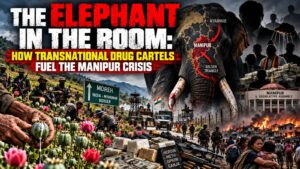
For years, the public discourse surrounding the protracted crisis in Manipur has remained rigidly locked within a bitter ethnic binary. Across valley towns and hill districts, communities, civil society organizations, youth groups, and media outlets have engaged in a relentless cycle of mutual recrimination. They identify each other as the primary existential threat. Yet, this intense polarization has completely blinded the populace to the massive elephant in the room: an entrenched, transnational drug syndicate that weaponizes identity politics to protect its illicit profits.
To understand the unending turmoil in Manipur from its inception to the present day, one must dare to look past the smoke screen of ethnic friction and confront the massive narcotics economy. The armed militancy, the illegal encroachments, the coercion of democratic institutions, and the tragic loss of human life are not isolated symptoms of communal hatred. They are the calculated byproducts of a multi crore drug empire.
THE MYTH OF A PURELY ETHNIC CONFLICT
While historical and cultural fault lines certainly exist in Manipur, the trajectory of the ongoing violence reveals a much darker economic engine. The “War on Drugs” launched by the state administration laid bare the staggering scale of illegal poppy and ganja cultivation thriving in remote hill tracts. These are not modest, subsistence farms. They are industrial scale agricultural operations managed by heavily armed cartels sitting uncomfortably close to the Golden Triangle’s transit corridors.
These cartels rely on a steady, illegal pipeline of cheap, undocumented labor sourced across porous international borders, primarily from Myanmar. This foreign labor force is incentivized and sustained by promises of shelter, food, and forged documents to gain Indian citizenship in exchange for toiling in the illicit fields and processing labs for lower wages.
A Rs 70,000 CRORE NARCO-ECONOMY CRUSHING A Rs 55,000 CRORE GDP
The sheer economic power of this criminal enterprise explains why the conflict refuses to die. Reports estimate the illegal drug market operating through Manipur has ballooned to over a staggering ₹70,000 crores. This vastly exceeds Manipur’s entire official Annual Budget, which hovers around ₹55,000 crores. When an illicit syndicate possesses financial war chests larger than the state government’s entire legitimate economy, it holds the absolute power to buy political allegiance, fund private armies, acquire military grade weaponry, and bankroll endless communal chaos to safeguard its profits.
COERCED DEMOCRACY AND LEGISLATIVE CAPTURE
The most harrowing reality of this crisis is how these criminal syndicates have completely subverted governance. In the hills of Manipur, elections are no longer a free expression of the public will. Armed, drug peddling factions dictate who can campaign or stand for elections, literally capturing the democratic process at gunpoint.
Consequently, these elected officials in the Manipur legislative assembly from the hills owe their power not to the electorate, but to the ruthless cartels that funded and coerced their rise. This explains the frustrating legislative paralysis and the persistent institutional reluctance to dismantle the networks. When lawmakers are captive to criminal syndicates, their primary mandate shifts from public welfare to shielding the supply chains and territory of the drug lords.
THE COMPLICITY OF THE HIGH COMMAND: FORCES LOOKING THE OTHER WAY
Adding to the outrage is the glaring paradox of Manipur’s heavily militarized landscape. The hill districts are saturated with tens of thousands of security personnel, heavily armed and equipped with advanced surveillance technology. Yet, vast swathes of illegal poppy and ganja fields continue to flourish in plain sight under their watch. While there are highly publicized eradication drives, critics argue these often serve merely as cosmetic performances.
The public is left asking an unavoidable question: how can industrial scale illegal poppy cultivation, requiring massive land clearance, daily labor, and complex logistics, thrive in zones under intense military control? This apparent blindness is not an accident. The fact that the deployed forces are deliberately looking the other way exposes a chilling reality: the high commands at both the state and central levels simply do not want the destruction of the poppy fields. This institutional complicity suggests a top down political instruction to protect the cartel economy, preserving corrupt alliances and illicit financial flows while the state burns to the ground.

THE BLINDNESS OF PUBLIC DISCOURSE AND THE MAFIA MENTALITY
Today, everyday citizens across all communities are the ultimate victims. They bear the devastating human cost, live in constant fear, and feel like orphans abandoned by the state, while the architects of the illicit economy sit back and watch communities tear each other apart. Every time pressure groups and media houses frame the conflict solely through a communal lens, they inadvertently provide perfect cover to the drug lords.
An ideological conflict can be resolved through political dialogue and compromise. However, a conflict driven by narcotics and criminal enterprise has a built in incentive never to end, a phenomenon known as the mafia mentality or mindset.
Peace directly threatens the supply lines, illegal taxation, and political protection that keep these syndicates insanely profitable.

THE ONLY PATH FORWARD: A TWO PRONGED ERADICATION
The salvation of Manipur hinges on a decisive strategy. If the state is to heal, the public must awaken to the reality that the turmoil will never cease through cosmetic peace accords or surface level condemnations. The only tangible and permanent solution requires a total, uncompromised war on the drug infrastructure through two absolute steps:
- TOTAL ERADICATION OF CULTIVATION AND CARTEL INFRASTRUCTURE: Every illegal poppy and ganja plantation must be systematically destroyed. The armed operators and political enablers shielding them must face ruthless, unyielding military and legal action regardless of political alignments or truce pacts like the Suspension of Operations (SoO) agreements.
- SEAL INTERNATIONAL BORDERS AND CUT OFF THE LABOR PIPELINE: The borders must be rendered impenetrable through advanced fencing and strict technological surveillance. This will permanently cut off the inflow of cheap labor, illegal migration, and transnational trafficking routes that form the very backbone of the cartel economy.
The citizens of Manipur and the rest of India must force both the state and central governments to stop playing political games and actually deploy the massive military presence already stationed in the region for its intended purpose. Tens of thousands of heavily armed troops, paramilitary forces, and federal police are currently on the ground, yet they are paralyzed by the high command’s tacit approval of the narco economy. New Delhi and Imphal must be held totally accountable. They must be legally and publicly compelled to unleash these forces not for managing optics, but for a singular, ruthless objective: the absolute eradication of the drug cartels.
The military must be ordered by the high command to burn every illicit field, dismantle every hidden laboratory, and hunt down the syndicate bosses, rather than looking the other way to preserve fragile, corrupt political alliances. The narcotics trade was not a passive beneficiary of Manipur’s strife; it actively engineered the chaos with financial resources exceeding the state’s official GDP. True victory will only come through a full scale, militarized campaign against those pulling the strings.
Until the public, civil society, and media unite to confront the true elephant in the room and fiercely demand the total elimination of the drug cartels, Manipur will remain trapped in a manufactured cycle of violence, bleeding for the profits of a criminal few.
REFERENCES:
- Drug Economy & Scale of Seizures: Authorities report destroying illicit poppy and seizing drugs valued at ₹70,000 crore, arresting over 2,000 to 3,000 individuals.
- Conflict Casualties & Origins: News reports document the origins of the conflict starting May 3, 2023, confirming that over 250 people have been killed in the ethnic violence.
- Myanmar Opium Cultivation Data: The United Nations Office on Drugs and Crime (UNODC) Southeast Asia Opium Survey confirmed Myanmar had 47,100 hectares under opium-poppy cultivation in 2023, an 18 percent increase from the previous year.
- Election Intimidation at Gunpoint: The National People’s Party (NPP) issued urgent communications before the 2022 state elections accusing militant outfits of widespread intimidation and abuse of power against candidates and voters in Manipur.
- Political Complicity and Cabinet Suspicions: Public records and regional media document the ongoing allegations surrounding political interference in high-profile drug cases (including those brought forward by police officer Thounaojam Brinda) and demands by the political opposition to investigate ministers linked to the drug trade.
- Institutional Breakdown: Human Rights groups and India’s Supreme Court have formally documented the massive breakdown of constitutional order, including the large-scale looting of weapons from state armories.