

Based on Myanmar’s political and security landscape as of September 2026, this report evaluates the implementation status and viability of key CMEC projects and future trajectory.

By Lt Col Ujjual Abhishek Jha, Retd
At a glance, the China-Myanmar Economic Corridor (CMEC) suggests a bold strategic move by China; a multi-billion-dollar network of ports, railways and pipelines offering a shortcut to the Indian Ocean Region (IOR) to bypass the critical Strait of Malacca and transform Myanmar into a regional hub. Almost a decade on, the ground reality is different. Most projects remain stuck at the planning stage or on paper, except for the oil and gas pipelines that were already operational before CMEC was formally launched.
The setback isn’t a lack of drive, but the internal conflict and fractured landscape in Myanmar. Since the military transfer of power in February 2021, an ongoing internal conflict has fragmented the country into zones of contested territory. Presently, these contested territories lie along the primary route of the CMEC. Although China is pushing harder to maintain its strategic footholds, such as the Kyaukphyu deep-sea port and critical rare-earth extraction sites, the broader corridor is largely undermined. For now, China is forced into a high-stakes balancing act, brokering local ceasefires, while its strategic infrastructure plans wait on the sidelines of an internal conflict.
Based on Myanmar’s political and security landscape as of September 2026, this report evaluates the implementation status and viability of key CMEC projects and future trajectory.
Strategic Rationale of CMEC
China’s Drive – CMEC provides landlocked Yunnan its shortest route to the IOR and reduces the reliance on the Malacca Strait, which is a major strategic vulnerability. Beyond securing gas, hydropower and rare earths, it also initiates secures access to Myanmar’s resources and development in southwestern provinces of China.
Myanmar’s Stake – The corridor is envisioned as a developmental model exploring possibilities of upgraded infrastructure, employment and crucial energy royalties. Importantly, it offers Myanmar with Chinese capital at a critical juncture (a rare lifeline to boost its struggling economy) wherein, western investors have pulled back after the 2021 and subsequent sanctions.
Regional Impact – The corridor raises the stakes. China’s growing presence in Bay of Bengal and thereby IOR raises deeper concerns for India and even to the USA in IOR.
Present Status of Major CMEC Projects
Governance Structure – The CMEC is a key infrastructure initiative under China’s Belt and Road Initiative, formally established through a Memorandum of Understanding (MoU) signed on September 9, 2018, by He Lifeng, Chairman of China’s National Development and Reform Commission (NDRC) and Myanmar’s Ministry of Planning and Finance. Project implementation is managed through joint steering bodies within Myanmar’s Ministry of Investment and Foreign Economic Relations (MIFER) alongside the NDRC.
CMEC comprises a mix of strategic infrastructure, energy assets, urban development and border economic zones. Their implementation status ranges from fully operational (pipelines) to indefinitely stalled (New Yangon City) to actively contested by internal conflict (Kyaukphyu port, Muse-Mandalay railway). The details of all key projects is summarised below.
| Project | Investment | Location | Stakeholders | Status as of September 2026 | Highlight / Challenges |
| Kyaukphyu Deep Sea Port | $1.3 Bn Phase 1 (renegotiated from $7.3 Bn) | Kyaukphyu, Rakhine | CITIC Group, Myanmar Port Investment Ltd / Myanmar Govt | Environmental Social Impact Assessments (ESIA) incomplete, no material construction | Conflict around Kyaukphyu, increased Arakan Army controls, Nearby Chinese-backed power plant dismantled/ relocated in Feb 2026 |
| Kyaukphyu SEZ (KPSEZ) | $1.5 Bn | Kyaukphyu, Rakhine | CITIC Group | ESIA incomplete | March 2025 talks to expedite. Part of combined Port & SEZ, stalled by AA controls |
| Muse-Mandalay- Kyaukphyu Railway | $8.9-9.0 Bn (consolidated corridor) | Muse-Mandalay- Kyaukphyu | China Railway Eryuan Engineering Group (CREEC/CREEG), Myanmar Railways | Trapped in preparatory stage, Field survey impacted, Junta claims of ongoing construction | Route through conflict zones controlled by ethnic armed groups, China continues construction on Dali-Ruili side. |
| Mandalay-Tigyaing-Muse Expressway | $820 Mn | Shan | Not Known | Stalled | Part of structural network for corridor |
| Kyaukphyu-Naypyidaw Highway | $2.15 Mn | Rakhine to Naypyidaw | Not Known | Planning, stalled | – |
| China-Myanmar Oil & Gas Pipelines | Operational asset | Kyaukphyu to Kunming | CNPC (50.9%), MOGE, South Korean & Indian investors | Fully operational and expanding | Existing asset under CMEC. Heavily guarded and resilient, but costly for locals |
| Kyaukphyu Power Plant | $180 Mn (VPower + CNTIC JV $140 Mn) | Kyaukphyu | VPower Group + CNTIC JV | Completed 2023, suspended late 2023, dismantled/relocated Feb 2026 (enhanced early 2026) | Suspended due to junta failure to supply gas and pay in USD |
| Mee Lin Gyaing LNG Terminal | $2.5 Bn | Ayeyarwady Region | Not Known | Early design stage | Revived post-2021 |
| New Yangon City Project | $1.5-8 Bn (depending on phase) | Yangon | NYDC, CCCC | Pre-construction / Planning stage | Yet to complete layout. Issue over 5:95 revenue split favouring China in Phase 1 |
| Chinshwehaw CBECZ | Conceptual | North Shan State | Myanmar Ministry of Commerce & Chinese Ministry of Commerce | Conceptual / Stalled, disruption due to conflict | CBECZ. Part of 8 border gates, only Muse-Ruili consistently open |
| Kanpiketi CBECZ | $22.4 Mn / Conceptual | North Kachin Special Region | Myanmar Ministry of Commerce & Chinese Ministry of Commerce | MoU to be signed / Conceptual phase | CBECZ – disruption due to conflict |
| Muse-Ruili CBECZ | Conceptual | Muse-Ruili border | Myanmar Ministry of Commerce & Chinese Ministry of Commerce | Planning / Conceptual – only consistently open gate | CBECZ |
| Mandalay Myotha Industrial Park | $500 Mn | Mandalay | Not Known | Completed | – |
| Myitsone Dam | $11.5 Bn (revised from $3.6 Bn) | Kachin | Ministry of Electric Power, Asia World Co | Suspended in 2011, revived Dec 2025 with reduced height | Red line by KIA, active conflict and earthquake-prone |
Viability Evaluation for CMEC Projects
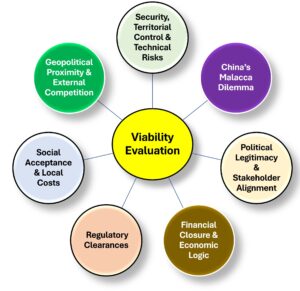
Evaluating the viability of the CMEC entails looking beyond finance and technology and examine the functioning of these projects amidst the ongoing internal conflict and contested zones. The viability of CMEC projects has been determined keeping in mind seven (07) essential considerations, their relevance with applicability.
| Considerations | Relevance | Applicability |
| Security, Territorial Control & Technical Dangers | Most CMEC routes run through contested zones in the internal conflict, mountainous terrain, seismic risks and long linear routes make them hard to secure | Low Viability – Muse-Mandalay Railway, Kyaukphyu-Naypyidaw Highway and projects in EAO zones (Kyaukphyu Port in Arakan Army area, Myitsone Dam in KIA area) where surveys and construction can’t be secured
High Viability: Assets that can be secured such as oil & gas pipelines, or low-CAPEX flexible sites like rare earth mining |
| Strategic Indispensability vs Operational Hedging (China’s Malacca Dilemma) | Criticality and strategic value of CMEC for China to bypass the Malacca Strait – higher Chinese commitment | Selective Prioritisation – China protects high-value defendable assets while conceding exposed ones
Border Gates – Except Muse-Ruili (moderate – high viability), other seven gate remain disrupted |
| Political Legitimacy & Stakeholder Alignment | Fragmented governance and now stakeholders are junta, local communities and armed groups | Contract Issues – revenue split favoring China, renegotiation and debt fears
Asset Interruption: Kyaukphyu Power Plant completely dismantled, post junta failure to supply gas and pay in USD |
| Financial Closure | Need of USD 1 – 11 Bn for Flagship projects and Forex crisis, inflation, fiscal collapse in Myanmar leading to its lack of funding and purchase guarantees | Low Viability – Muse-Mandalay Railway, Mee Lin Gyaing LNG stuck at MoU/ feasibility with no financing
Moderate – Mandalay Myotha Industrial Park built but underutilized due to power and economic collapse. High – Oil & gas pipelines already built, generating revenue |
| Regulatory & Environmental Clearances | Without Environmental and Social Impact Assessments (ESIAs) and resolving legacy issues – no international finance or commence actual construction | Low – Moderate – Kyaukphyu Deep-Sea Port & SEZ, incomplete ESIA, no ground work
Low – Very Low – Myitsone Dam, revival blocked by unresolved compensation and environmental liabilities from 2011 |
| Social Acceptance and Local Costs | Land displacement and environmental damage – anti-China sentiment amongst local communities and EAOs | Red Lines – KIA declared revival of Myitsone Dam a non-negotiable red line, making it non-viable
High Local Cost – survival of pipelines only through secured areas, friction with locals, along the route |
| Geopolitical Proximity & External Competition | CMEC into Kachin and Rakhine – dissent from India and West, forcing China to get directly involved in security | China shifts to security-focused posture, brokering ceasefires, arranging militia protection and negotiating directly with EAOs to keep corridor influence intact |
Viability Classification
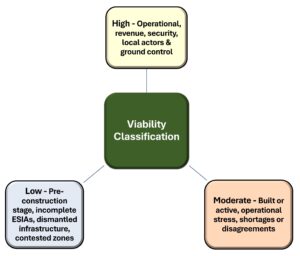
- High Viability – Operational, revenue-generating, physically secured, accepted/ operated through locals controlling the ground.
- Moderate Viability – Active but operational stress due to ongoing conflict, power deficits, foreign exchange shortages or policy/ revenue disputes.
- Low/ Very Low Viability – Pre-construction stage, incomplete ESIAs, lack of financial closure, dismantled infrastructure or sited in actively contested zones, without non-state actor alignment.
Project-wise Viability Assessment of CMEC
| Project | Viability | Brief Reasoning |
| Kyaukphyu Deep-Sea Port | Low | No material construction, ESIA incomplete. Rakhine majorly under AA control. Nearby power plant dismantled Feb 2026. High security & debt risk despite strategic value for China |
| Kyaukphyu SEZ (KPSEZ) | Low | Tied to port, EIA still ongoing, AA controlled conflict zone, no infrastructure or investor traction |
| Muse-Mandalay Railway | Low | Struck in preparatory stage since 2019, Field surveys blocked by EAOs control in Shan, USD 8.9-9 Bn cost unfinanced, China only building Dali-Ruili railway |
| Mandalay-Kyaukphyu Railway | Low | Extension of above corridor to port, no progress, route through contested Rakhine and central Myanmar, dependent on Muse-Mandalay section |
| Kyaukphyu-Naypyidaw Highway | Low | Planning stalled, likely underfunded, no progress in survey |
| China-Myanmar Oil & Gas Pipelines | High | Fully operational and expanding since 2013, only CMEC asset delivering revenue, heavily guarded despite considerable costs to local communities |
| Kyaukphyu Power Plant | Low – Failed | Completed in 2023 but suspended in late 2023 for non-payment in USD and lack of gas, dismantled/ relocated Feb 2026, no longer viable |
| Mee Lin Gyaing LNG Terminal | Low | Early designing stage, revived post-2021 but no financing or EIA, high market risk |
| New Yangon City Project | Low | Pre-construction, layout incomplete, revenue split (5:95) favouring China in Phase 1 led to public dissent and financing issues |
| Chinshwehaw CBECZ | Low | Conceptual, North Shan conflict, border gate intermittently closed, no infrastructure |
| Kanpiketi CBECZ | Low | KIA influence, no trade volume, no access road |
| Muse-Ruili CBECZ | Moderate | Only consistently open gate out of 8 border gates, most viable CBECZ, but exposed to conflict and customs uncertainty |
| Mandalay Myotha Industrial Park | Moderate | Completed, underutilized due to power cuts, poor logistics, viable as industrial site but weak investment |
| Myitsone Dam & Upper Ayeyarwady Cascade | Low | Suspended since 2011 public opposition, revived in Dec 2025 with reduced height but KIA declared red line, earthquake-prone, conflict zone, unrealistic timeline |
Overall Viability Analysis of CMEC
Core Constraint: A Fragmented & Contested Myanmar – Five years after 2021, Myanmar remains widely divided, with anti-junta forces and Ethnic Armed Organisations controlling almost 95 townships. Since, all the major projects of CMEC passes through actively contested or ongoing conflict areas, therefore, ongoing internal conflict remains the pivotal threat to the success or improving viability of the CMEC. This also implies that internal conflict overshadows other issues like funding, feasibility or diplomacy.
China’s Strategy: Navigating Through Instability – China has not abandoned CMEC, but its approach has shifted toward pragmatic risk management. To safeguard its investments, China now brokers regional ceasefires, advances border-side infrastructure in Yunnan and engages opportunistically with whichever armed faction controls the territory. Ultimately, there is no substitute for a stable local government capable of securing the corridor.
Financial Reality: Growing Risks – Financial troubles run just as deep as the war. With foreign investment dipping by nearly 75% since 2021, Myanmar simply can’t afford these multi-billion-dollar price tags. Scaling back the Kyaukphyu port shows real anxiety about falling into a debt trap, especially since a battered economy can’t generate enough trade to pay off mega-projects of this scale.
Divergent Viability of CMEC: Mixed Prospects
- Oil & Gas Pipelines – High viability, already built and generating revenue, these assets.
- Ports & Dams (Kyaukphyu, Myitsone) – Low to moderate prospects with long-term value, but short-term progress will be slow and symbolic with constant delays.
- Railways – Lowest viability in the present scenario as multiple actors contesting makes the project nearly impossible right now.
- Urban Development – Stalled not by ongoing conflict but by poor economic state.
Synthesis – From Blueprint to Reality
The viability of CMEC as a single, seamless trade corridor connecting China to the Indian Ocean over the next three to five years appears low. However, when viewed as a flexible bundle of individual projects pursued opportunistically, its viability is moderate. Until Myanmar achieves stability, China is likely to continue advancing its interests project by project rather than waiting for conditions to align.
Possible Scenarios: 2026-31
| Scenario | Likelihood (Indicative) | CMEC Implication |
| Continued stalemate (status quo) | Most likely | Selective progress |
| Negotiated federal settlement / durable ceasefires with major EAOs | Long-term Possibility | Meaningfully improves prospects but may require re-negotiation of legitimacy and terms of existing project deals |
| Decisive junta victory | Low-moderate | May progress inland construction but at high humanitarian cost and continued international isolation, will also complicate finance beyond China |
| Escalation / Deeper fragmentation | Complex | Turns CMEC into a maritime/ energy corridor only |
Way Ahead
- China
Protect what works, delay what does not – Focus on what is already secure. Protect the pipelines and Kyaukphyu and expand them slowly. Keep building the rail link inside China, but treat the full cross-border railway as a long-term plan, not an immediate deliverable.
Talk to everyone who holds ground – Maintain working ties with the junta, key EAOs like the KIA and Arakan Army and border controlling forces at the same time to keep the flow of trade and resource moving. Use of ceasefire brokering to reopen border crossings where conflict hits their core interests.
- Myanmar
Renegotiation on Cards – Any administration, junta or successor civilian led government, will have to review deals signed for legality, fairness and debt sustainability, likely means renegotiation.
Federal Set-up may help CMEC – Contrary to expectations, a peace process that gives EAOs formal, recognised authority over their territories would improve project viability. It would create stable, legitimate counterparts to negotiate with along the corridor. This outcome is not yet pursued seriously either by the junta or China.
Diversification of Relations – Reduce dependencies on China alone and diversify partners to include India, Japan, ASEAN and possibly West. This would give Myanmar more leverage and better negotiating power on CMEC.
On paper, CMEC is a masterstroke in trade diversification and Indian Ocean access, however, on the ground, it is a high-risk gamble. Its viability pivots entirely on Myanmar’s volatile internal security landscape. Until persistent internal conflict, political instability and security risks in Myanmar are resolved, CMEC will remain a high-value geopolitical blueprint struggling against low-viability ground realities.
(Lt Col Ujjual Abhishek Jha, Retd is a Certified Data Privacy Professional and Strategic & Geopolitical Advisor with over two decades of experience in intelligence, insider threat management, financial crime investigations, and geopolitical risk analysis, advising on complex security and strategic risks.)