

The decision by the Myanmar-based Eastern Flank of the NSCN (IM) to announce formation of a Provisional Government comes as no surprise, rather, it is the culmination of long-standing internal frustrations. Beyond the immediate political drama, this split poses a genuine threat to the fragile ceasefire, deepens instability along the IMB and raising fundamental questions over political legitimacy within the Naga outfits.

By Lt Col Ujjual Abhishek Jha, Retd
Abbreviations Used in the Article:
NSCN – National Socialist Council of Nagaland/ Nagalim
NSCN (IM) – National Socialist Council of Nagalim (Isak-Muivah)
NSAZ – Naga Self-Administered Zone
GoI – Government of India
NPP – Naga Peace Process
IMB – Indo-Myanmar Border
NNPG – Naga National Political Groups
NSCN (K) – National Socialist Council of Nagaland (Khaplang)
Ikato Chishi Swu {son of the late Isak Chishi Swu, founding Chairman of NSCN (IM)}, issued a statement on 23 September 2026 as Chairman of the NSCN Provisional Government from Mt. Horeb camp in the NSAZ, Myanmar. The statement marks a decisive split that had been developing since he left Camp Hebron, the headquarters of NSCN (IM), in April 2025 to join the Myanmar-based Eastern Flank. The formal split was announced on 21 July 2026 during an Extraordinary Joint Emergency Meeting of the Eastern Flank, which declared the formation of a Provisional Government. The group refused to accept expulsion orders issued against some of its leaders by the Hebron leadership and rejected the ‘Competencies’ document submitted by NSCN (IM) to the GoI on 02 January 2020.
The report examines the statement and summarises the key highlights, bring forth the “Competencies” and the specific oppositions of the Eastern Flank and explores likely future trajectories.
The Statement of 23 September 2026
This statement lays out the standard history of the Naga movement, starting from the 1929 memorandum with early calls for self-rule and running through decades of ceasefires, internal splits and unsettled agreements. While the 2015 Framework Agreement aimed to end the conflict, fundamental disagreements over ‘shared sovereignty’ created a deadlock with NSCN (IM) demanding a separate flag and constitution and the GoI asserting on solutions within the ambit of the Constitution of India. Amidst this ongoing deadlock, the Myanmar-based Eastern Flank grew autonomous and ultimately broke away, marking symbolic weight to the rift.
Key Highlights
The statement, issued over the signature of Ikato Chishi Swu as the Chairman, reiterating the historical claim of Naga sovereignty and then pivots to a sharp critique of the Hebron leaderships and its talks with GoI. Its principal declarations can be grouped as follows.
Reassertion of the Sovereignty Claim – The group firmly reasserts that Naga villages were historically independent republics, culturally and politically distinct from both India and Myanmar. It points to key milestones – the independence declaration of 14 August 1947, the 1951 plebiscite, and the boycott of early Indian elections, as the foundation of the Naga right to self-determination.
Grievance Narrative – The statement highlights a history of harsh security tactics and argues that the Naga issue is a political conflict that cannot be solved by force. It presents decades of negotiations as a series of broken promises culminating in the collapse of the peace process, noting that Th. Muivah himself warned on 07 November 2024 of a return to armed conflict.
Formation of the Provisional Government – In response to the deadlock, Eastern Flank leaders met at Mt. Horeb in July 2026 to form a Provisional Government led by Ikato Chishi Swu. They completely rejected recent expulsion orders from the Hebron leadership, declared the ceasefire dead, and affirmed the new faction’s commitment to restoring full Naga sovereignty.
The “Competencies” Underlined
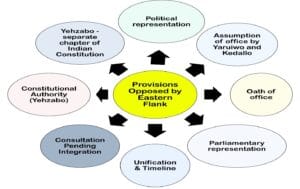
The “Competencies” is a proposal that the NSCN-IM reportedly submitted to the GoI on 02 January 2020. The document was meant to elucidate how powers would be shared between GoI and Nagas under Framework Agreement of 2015. The Eastern Flank’s objection is that, instead of keeping the “shared sovereignty between two entities”, that it says the Framework Agreement promised, the document places Nagas within the Constitution of India. The statement lists eight specific provisions it finds unacceptable, which are tabulated below.
|
Provision |
Objection of the Eastern Flank |
|
Political representation |
Subordinating Naga electoral autonomy (Tatar Hoho’s Election Commission) to an Indian institution (Election Commission of India). |
|
Assumption of office by Yaruiwo and Kedallo |
Requiring the President of India to proclaim the assumption of office by the Naga President (Yaruiwo) and Vice-President (Kedallo), imposing Indian presidential authority over Naga leadership. |
|
Oath of office |
Mandates that Naga Ministers (Kilonsers) take their oath before the State Governor, thereby subordinating Naga executive authority. |
|
Parliamentary representation |
Including Naga representatives in both the Lok Sabha and Rajya Sabha embeds the Naga nation directly within the Indian parliamentary system. |
|
Unification & Timeline |
The process and timeline for integrating Naga-inhabited areas remain open-ended and legally unenforceable. |
|
Consultation Pending Integration |
Relying on a temporary provisional setup to consult with the Pan Naga Hoho until integration occurs, leaves Naga territorial unity in indefinite deadlock. |
|
Constitutional Authority (Yehzabo) |
Questions whether constituent authority remains with the Nagas or is conceded to GoI. |
|
Yehzabo as a separate chapter of the Constitution of India |
Incorporating the Naga Constitution as merely a separate chapter within the Constitution of India merges the Naga identity into the Indian legal order. |
Note: The provisions above are summarised from the 23 September 2026 statement. The Competencies document itself has not been officially released in full by the GoI or by NSCN-IM and its text is known primarily through selective disclosures of NSCN (IM).
Implications
By formally rejecting these specific clauses, the 2026 split is no longer just about policy differences. It has become a question of legitimacy, whether the Hebron leadership still has the right to speak for the Nagas. The Provisional Government of Eastern Flank says that if Naga elections, oaths and constitutional powers are placed under Indian institutions, it goes against the founding principles of the movement. So, the issue is no longer just about the GoI and NSCN (IM) disagreeing over terms. It is now a deep internal rift over who really holds the mandate of the Nagas.
Security implications – The immediate threat lies in growing instability along the IMB. Although, the scenario of split in NSCN (IM) may not mirror the situation post-split in NSCN (K) in 2015, however, independent IMB based factions operates outside the preview of Ceasefire Ground Rules and peace initiatives. Further, any resurgence of non-negotiating Naga faction may intertwine and intensify the ongoing ethnic conflict in Manipur. In addition, the ongoing internal conflict in Myanmar provides safe heaven for the newly formed faction, thereby increasing security concerns along the IMB.
Political and organizational Implications – This split further fractures the NPP, presenting yet another stakeholder alongside established groups such as NSCN (IM) and NNPG umbrella. As the new Provisional Government is led by senior former NSCN (IM) leaders and son of founding Chairman, it commands genuine authority that Hebron leaders cannot simply overlook, as highlighted by multiple public denials and clarifications since late 2025 by NSCN (IM).
Impact on NPP – The splinter faction, if able to gain wider legitimacy, may lead peace initiatives into disarray, creating a situation wherein, GoI negotiates with Provisional Government or haste some arrangement with the NSCN (IM), which may have backlash of locals. In the present scenario, the split is detrimental to the credibility of NSCN (IM) under an aging leader, Th Muivah.
Likely Future Scenarios
There can be four primary possibilities for Provisional Government, Eastern Flank, in future. Provisional Government remains a small fringe group along the IMB and fails to draw away cadres from Hebron. This will reduce them to marginalized faction without any impact on NPP. The group can alternatively escalate into low-intensity conflicts. In case the faction gains traction, it could establish itself as an alternative negotiating group thereby adding more complexity to peace negotiations. Lastly, there is a possible path where Naga CSOs including religious leaders navigate through the differences and mediate a reconciliation to avert further division and increasing complexity in NPP.
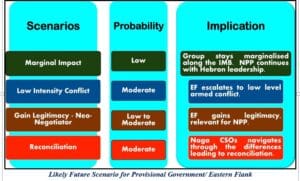
In the present context, given the Provisional Government’s operational reach (seen in the suspected Ukhrul ambush and Dimapur incident), the symbolic weight of its leadership, and the Hebron leadership’s hesitation to either reconcile or disown the faction, a combination of Scenarios B and C appears most likely. This path would see sporadic low-level violence alongside efforts by the Provisional Government to build wider legitimacy. However, reconciliation (Scenario 4) remains a plausible long-term outcome, given historical Tangkhul unity.
Conclusion
The decision by the Myanmar-based Eastern Flank of the NSCN (IM) to announce formation of a Provisional Government comes as no surprise, rather, it is the culmination of long-standing internal frustrations. Beyond the immediate political drama, this split poses a genuine threat to the fragile ceasefire, deepens instability along the IMB and raising fundamental questions over political legitimacy within the Naga outfits. For the GoI, the key challenge will be managing the immediate security fallout without compromising long-term peace initiatives.
(Lt Col Ujjual Abhishek Jha, Retd is a Certified Data Privacy Professional and Strategic & Geopolitical Advisor with over two decades of experience in intelligence, insider threat management, financial crime investigations, and geopolitical risk analysis, advising on complex security and strategic risks.)