

Amidst the strict patriarchal social system, few strong women broke conventions, defied norms, and proved that women’s voices could shape the cultural soul of a society.
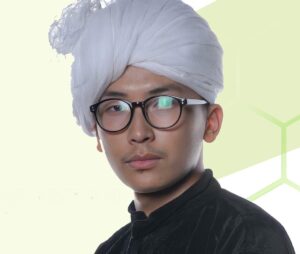
By Marjing Mayanglambam
As I learned from the stories narrated during casual talks and lectures by our Gurus, Moirang Sai came into existence around the end of World War II. Those were changing times. Young Manipuri women began performing songs and dances to entertain army officers and soldiers stationed in the region. Among those songs was the Marabak Eshei, perhaps meaning “Songs from Abroad.” It was, in many ways, a bold and revolutionary act for women to emerge as entertainers in a deeply patriarchal society.
Over time, these performances evolved. The common folk began to hear songs about Khamba and Thoibi, and it was said that the audience themselves coined the term Moirang Sai during one such performance by Langathel Thoinu, the daughter of a renowned Pena Asheiba. There have been debates about the use of the word “Sai” and its connection to Manohar Sai, but what is undeniable is that Moirang Sai carries the melodic soul of Nat Sankirtana, interwoven with Bengali and Sanskrit influences. The beauty of this cultural integration, its tunes, its lyrics, and its rhythm is truly beyond words.
Now, I must admit, some might consider my views heretical, especially those who insist that every Manipuri folk or traditional song should remain “pure” and “original.” But art, in my view, has always evolved through exchange and adaptation. Purity in art is often a myth, while expression is its eternal truth.
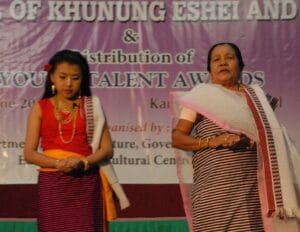
I had the great fortune to meet and perform alongside the legendary Guru of Moirang Sai, Langathel Thoinu, whom I lovingly call Bobok. For many years, I witnessed the sacred system of Guru Shishya Parampara or Oja Khanba, which my elder sister followed under Oja Thoinu. This was not the kind of learning we see today with mobile recordings, weekend practices, or brief workshops. My sister lived with her Guru, under the same roof, almost as a family member. The teaching was not limited to singing; it was about discipline, patience, humility, and, above all, respect for the art form.
If Moirang Sai were to have a parent, it would be the Pena Eshei. The art form borrowed from the Pena tradition, refining and energising it to retell the immortal love story of Khamba and Thoibi. The male accompanists play the Dhulok (percussion), Pena, and occasionally Toudri or Bashi (flute), giving the performances an elevated musical depth. Among its many tales, Thoibi Loi Kum Loi Ka, which narrates the exile and triumphant return of Princess Thoibi, remains the most beloved.
In recent years, Moirang Sai has ventured into contemporary musical experiments. While not all results are perfect, the exploration itself shows that the art form still breathes, evolves, and speaks to new generations. Personally, I find its traditional form most enchanting—its cadence, its poise, its emotional gravity. Yet I also believe that art belongs to its listeners, and how one perceives its beauty is deeply personal.
Any traditional or folk form will inevitably fade if people stop listening, but Moirang Sai seems blessed. Many young people today still appreciate and support it, thanks to the tireless dedication of performers who never abandoned this art.
Among the three founders of Moirang Sai, Langathel Thoinu was one, alongside Moirang Jati and Kumbi Inakhunbi. Each brought a unique style and flair, and together they once filled Manipur’s air with songs at births, weddings, weaning ceremonies, and festivals. Their emergence was not just musical; it was social. Amidst the strict patriarchal social system, these women broke conventions, defied norms, and proved that women’s voices could shape the cultural soul of a society. They empowered themselves through music and, in doing so, empowered others.
Today, thanks to my sister Mangka Mayanglambam and her colleague of Moirang Sai, Pinky Saikhom, the disciples of Oja Thoinu, this heritage continues to thrive. They are teaching a new generation to sing, to understand, and to feel the essence of Moirang Sai.
Moirang Sai carries more than the tale of Khamba and Thoibi; it carries the legacy of those who kept singing, teaching, and believing. It carries the strength of Manipuri women who turned song into resistance, rhythm into identity, and performance into empowerment.
And to you, dear readers, if you listen to or cherish traditional and folk songs, you too are part of this living story. Through your love and appreciation, Moirang Sai continues to sing on, not as a relic of the past, but as a living, breathing melody of our collective heritage.
(Marjing Mayanglambam is currently pursuing M.A. Folklore & Culture Studies. He is also a Pena Artiste & Researcher, Laihui Ensemble)