

A recent risk analysis by the XDI (Cross Dependency Initiative) in their Global Data Centre Physical Climate Risk and Adaptation Report (July 2025), around 8,868 data centres worldwide revealed that climate risks are not a distant future concern, they are already affecting data centre viability now and in the present.

By Salam Rajesh
Climate studies and impact assessments are taking haywire turns this decade with increased climate risks in the horizon, now and in the future. Extreme weather events are tearing apart much of the land, to the extent of creating a new terminology “climate refugees” as vulnerable and impacted populations loses homes and steads.
Apart of the climate risks to land and people from extreme weather events, the assessment also takes into account climate risks impacting global data centres around the world. A recent risk analysis by the XDI (Cross Dependency Initiative) in their Global Data Centre Physical Climate Risk and Adaptation Report (July 2025), around 8,868 data centres worldwide revealed that climate risks are not a distant future concern, they are already affecting data centre viability now and in the present.
The XDI’s analysis on the vulnerability of these data centres around the world focused on eight climate change hazards, which include Riverine and Surface Water Flooding, Forest Fire, Extreme Wind, Freeze-Thaw, Soil Movement, Tropical Cyclone Wind and Coastal Inundation. The analysis focused on the physical damage to building structures, examining how this risk increases over time.
The XDI’s risk analysis combined assets, climate change, and contextual data to determine asset vulnerability, hazard exposure and the likely physical and financial impacts on assets from climate change and extreme weather events.
The purpose of XDI’s climate risk analysis reflects the organization’s goal to accelerate actions on climate change by embedding physical climate risk data in all decisions by governments and scientific institutions on measures to tackle the climate crisis.
As part of the global exercise, 228 data centres across India were studied for the report. Across the country, the risk of damage to data centre infrastructure from climate change and extreme weather events tripled (180%) at the 2025-2100 projection, where the assessment analyzed that more than 12 percent of the data centres in India are projected to be on the high risk side by the year 2050.
XDI’s analysis in India centered on five data centre hubs in Uttar Pradesh, Chennai (Tamil Nadu), Mumbai (Maharashtra), Bengaluru (Karnataka) and Hyderabad (Telangana), where as in Uttar Pradesh’s case, 21 data centres in the State are analyzed as some of the most vulnerable to climate change extreme weather in the world.
Out of these 21 centres, a staggering 61.90 percent are already considered at high risk, ranking second in the XDI’s global analysis of data centre hubs. The risk of damage to data centre infrastructure from climate change hazards is projected to more than double (111%) by the end of the century.
In Maharashtra, which is considered having the highest concentration of India’s data centres, 5.71 percent of the data centres in the State are projected to be at high risk by 2050, with an overall risk of damage to data centre infrastructure more than doubling (133%) by 2100.
There are four existing or planned data centres in Maharashtra that the XDI’s analysis suggested could already be at high risk, and which require further investigation. The data centre hub in Maharashtra ranked 48th in XDI’s global risk analysis.
Across in Tamil Nadu, where numerous data centres are concentrated in Chennai, more than 1 in 10 centres are already at high risk and more than two-thirds are at moderate risk, according to the report.
The analysis showed how adaptations to the structure of data centres can reduce the risk of damage from climate change and extreme weather event impacts.
In the representative graph, the red column indicates the level of risk to data centre infrastructure in XDI’s first analysis. The blue column shows how the risk can be reduced when data centre infrastructures are adapted to increase resilience.
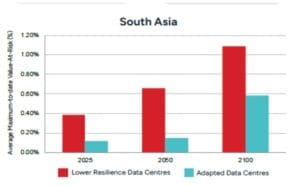
The analysis, thereto, indicated a possible 77 percent reduction in risk of damage to data centre infrastructure, and the percentage of High Risk data centres could be more than halved for the year 2050.
Out of 274 data centres in India analyzed for the study, including five operational hyperscale centres, six planned hyperscale centres, and 21 other planned data centres, the increase in the risk of damage to data centre infrastructure from climate change hazards was set to almost triple by 2100.
For the India country study, the year 2050 driving hazards assessment focused on the high risk threats from coastal inundation, riverine floods, and surface water flood. In South Asia, the high risk property damage analysis by the year 2050 has a projection of 10.22 percent, that is, more than 1 in 10 data centres in the subcontinent are projected to be classified as High Risk, vulnerable to extreme weather events.
The possible damages to these hyperscale data centres from climate change extreme weather impacts can incur huge loses, not only in the monetary measure but in infrastructural collateral loses suffered from climate change implications. The report inherently lays stress on climate change adaptation measures to minimize the impacts, and the possible loses.
In its conclusive suggestion, the report stressed that the data centres are critical infrastructure of the global digital economy, essential to everything from emergency communications to financial transactions and artificial intelligence. Yet, as the report makes clear, these facilities are increasingly exposed to escalating climate hazards that threaten their physical integrity, operational continuity, and insurability.
The report further stressed that these data centres underpin the systems of national security, financial stability, and global trade. When they fail, entire sectors can be disrupted, and perhaps leading to financial and other strategic loses, or collapses.
Lending a soft note of warning to investors, corporate and the State, the report reaffirms that the cost of inaction today will be measured not only in financial terms, but in the reliability of the digital infrastructure on which modern society depends.