

Despite official claims of 79.6% coverage and over ₹1,078 crore in central funds, villages across Manipur have dry taps, forcing residents to rely on streams and ponds; Court issues notices to state government.
TFM Report
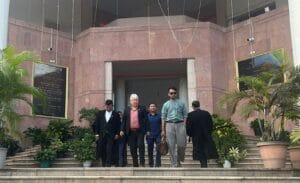
In a significant development, the High Court of Manipur on Tuesday (October 14) admitted a Public Interest Litigation (PIL) filed by Angomcha Bimol Akoijam, the Member of Parliament from Inner Manipur, alleging massive corruption, false reporting, and a complete failure in the implementation of the central government’s flagship Jal Jeevan Mission (JJM) in the state.
The PIL, which paints a grim picture of a “cosmetic compliance” scheme where water flows on official dashboards but not from taps, was heard by a Division Bench comprising Chief Justice M. Sundar and Justice Ahanthem Bimol Singh. The court has issued notices to the State of Manipur and its officials, demanding their responses.
The Core Allegations: A Scheme Sans Water
The petition, filed through Advocate Hijam Chandrakumar, alleges a staggering disconnect between government data and ground reality. While official data presented in Parliament claims that 79.6% of Manipur’s rural households (3.59 lakh homes) now have Functional Household Tap Connections (FHTCs), independent investigations and citizen testimonies tell a different story.
The PIL contends that a significant number of these “functional” taps are “non-operational, dry, or never connected” to any sustainable water source. It cites extensive media reports from districts like Senapati, Ukhrul, Chandel, Churachandpur, and Tamenglong, where villagers continue to trek long distances to fetch water from streams and ponds, despite being marked as “covered” under the ‘Har Ghar Jal’ scheme.
“Paper Taps” and Inflated Data: Evidence from the Ground
The petition annexes shocking examples of this alleged fraud:
* In Chandel district, the official JJM dashboard shows a 97.30% completion rate for Lennuvi village. However, civil society groups allege that not a single household in the village has received a functional tap water connection. They accused officials of counting five members of a single family as five separate households to inflate numbers.
* In Kachai village, Ukhrul, the JJM portal claims 612 out of 718 households have tap connections. The Kachai Village Authority has strongly condemned this as “fabricated information,” clarifying that pipeline laying hasn’t even begun.
* In Senapati district, Naga tribal communities have submitted a petition to the Governor, alleging a “massive scam.” They report that in many villages, isolated cemented taps with no connecting pipelines have been built merely to showcase “work done,” while the online dashboard falsely shows functional connections.
An investigative report by EastMojo in September 2025, titled “Water on Paper, Air in Taps,” is cited as evidence of the widespread nature of the problem.
The Financial Trail: ₹1,200 Crore Question
The PIL raises serious questions about the utilization of massive public funds. Based on replies from the Minister of State for Jal Shakti in Parliament, the petition states that a total of approximately Rupess 1,202 crore (1,078.82 crore from the Centre and 124.03 crore from the state) has been utilized for JJM in Manipur to provide tap connections to 3.33 lakh households.
Despite this enormous expenditure, the petition argues there has been “no transparent audit, third-party verification, or social accountability mechanism” to check if the funds were properly used or if the created infrastructure is functional. This, it claims, violates the Mission’s own guidelines and the public trust doctrine.
Violation of Fundamental Rights
Bimol Akoijam’s petition frames the administrative failure as a grave constitutional issue. It argues that the denial of clean drinking water violates the Fundamental right to life and dignity under Article 21 of the Constitution, which has been interpreted by the Supreme Court to include the right to clean water. It also cites a violation of Article 14 (right to equality), as the state’s arbitrary action deprives citizens of a basic amenity.
The petition highlights the health crisis, linking the consumption of untreated water from unsafe sources to recurring outbreaks of waterborne diseases like diarrhoea, typhoid, and jaundice in remote districts.
What the PIL Prays For
The MP has requested the High Court to issue several decisive directions, including:
- A writ of Mandamus to compel the state government to ensure a functional and continuous tap-water supply of at least two hours daily to all households within a fixed time-frame.
- The constitution of a Special Investigation Team (SIT) comprising individuals of “proven integrity” to investigate the irregularities and corruption in JJM implementation.
- Continuous monitoring of the investigation by the Court.
- Criminal and disciplinary action against officials and contractors found involved in misreporting, negligence, or diversion of public funds.
The Court’s Action and Next Steps
After hearing the matter, the Manipur High Court admitted the petition (registered as PIL No. 24 of 2025) and issued formal notices to the respondents—the State of Manipur, its Chief Secretary, the Secretary of the Public Health Engineering Department (PHED), and the Mission Director of JJM Manipur. The case has now been listed for its next hearing on November 18, 2025.
This PIL places the Manipur government in the hot seat, demanding accountability for a scheme that was meant to transform rural lives but, as alleged, has only succeeded on paper, leaving lakhs of citizens high and dry.