

Amplifying that the ozone layer is slowly recovering, the World Meteorological Organization (WMO) Ozone Bulletin 2024 noted that Earth’s protective ozone layer is steadily healing. The ozone hole last year was smaller than in recent years, according to the WMO’s latest report which contains welcome scientific news for peoples’ and the planetary health.

By Salam Rajesh
Announcing a welcome note for the world community in terms of the concerns on global warming implications and the steadily rising global temperatures in recent times, the World Meteorological Organization says the ozone layer remains on track to recovery in the coming decades.
Amplifying that the ozone layer is slowly recovering, the World Meteorological Organization (WMO) Ozone Bulletin 2024 noted that Earth’s protective ozone layer is steadily healing. The ozone hole last year was smaller than in recent years, according to the WMO’s latest report which contains welcome scientific news for peoples’ and the planetary health.
The WMO attributed the improvement to activities initiated under the Vienna Convention and the Montreal Protocol, evidently showcasing the benefits of science for global action. It noted that the stratospheric ozone protects peoples’ and the planetary health, and, therefore, the continued atmospheric monitoring is of vital necessity.
The WMO Ozone Bulletin 2024 reported that the low level of ozone depletion observed in 2024 was partly due to naturally occurring atmospheric factors which drive year-to-year fluctuations. However, the long-term positive trend reflects the success of concerted international action, it observed.
The Bulletin is being issued for the World Ozone Day observation on 16 September, and the 40th anniversary of the Vienna Convention, which recognized stratospheric ozone depletion as a global problem and provided the framework for mobilizing international cooperation in ozone research, systematic observations, and scientific assessments.
UN Secretary-General António Guterres says that forty years ago, nations came together to take the first step in protecting the ozone layer, guided by science and united in action. “The Vienna Convention and its Montreal Protocol became a landmark of multilateral success. Today, the ozone layer is healing. This achievement reminds us that when nations heed the warnings of science, progress is possible,” the UN chief said.
It may be recalled that the Montreal Protocol led to the phase-out of over 99 percent of the production and consumption of controlled ozone-depleting substances, which were used in refrigeration, air conditioning, firefighting foam, and even hairspray.
As a result, the ozone layer is now on track to recover to the 1980s levels by the middle of this century, significantly reducing risks of skin cancer, cataracts, and ecosystem damage due to excessive UV (Ultra Violet) exposure, the WMO Bulletin stated.
WMO Secretary-General Celeste Saulo observed that the WMO’s scientific research into the ozone layer dated decades ago, and it was underpinned by trust, international collaboration and commitment to free data exchange, all cornerstones of the world’s most successful environmental agreement to date.
Matt Tully, Chair of WMO’s Scientific Advisory Group on Ozone and Solar UV Radiation, however cautioned the world community, noting that, “Despite the great success of the Montreal Protocol in the intervening decades, this work is not yet finished, and there remains an essential need for the world to continue careful systematic monitoring of both stratospheric ozone and of ozone-depleting substances and their replacements”.
Protecting the ozone layer, and thereby human, environmental and agricultural health has enabled significant progress towards achieving many of the United Nations Sustainable Development Goals, including SDG 2 (Zero Hunger), SDG 3 (Good Health and Well-Being), SDG 13 (Climate Action), and SDG 15 (Life on Land), Tully said.
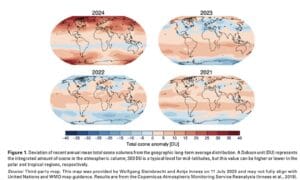
Compared to previous years, during the year 2024 the total stratospheric ozone cover was higher over much of the globe, according to the WMO Bulletin.
The depth of the 2024 Antarctic ozone hole, which appears over the Antarctic every spring, was below the 1990-2020 average, with a maximum ozone mass deficit (OMD) of 46.1 million tons on 29 September last year, the WMO Bulletin noted, while observing that the ozone hole was smaller than the relatively large holes observed between 2020 and 2023.
The onset was relatively slow, and delayed ozone depletion was observed through the month of September last year, followed by a relatively rapid recovery after the maximum deficit was reached. “This persistent later onset has been identified as a robust indication of initial recovery of the Antarctic ozone hole,” noted the Bulletin.
Supporting the implementation of the Montreal Protocol, the WMO-led community developed and implemented guiding principles for ozone and ultraviolet (UV) monitoring networks.
These principles aimed to ensure broad observational coverage, define standards for operations, data processing and calibrations, and to foster a network where scientists meet, exchange knowledge, receive training, and explore opportunities for collaboration.
The approach taken had proven invaluable for enabling effective and policy-relevant observations, and it is one of the keys to the success of the Montreal Protocol, according to the WMO Bulletin.
The Bulletin further traces the origin and progress in the Vienna Convention and the Montreal Protocol, and the subsequent Kigali Amendment of 2016, which committed signatories to reduce hydrofluorocarbons (HFCs) which are powerful greenhouse gases (GHGs) used as substitutes for ozone-depleting substances.
With the Kigali Amendment ratified by 164 parties as of date, the phase-down is progressing according to the agreed schedules and is expected to avoid up to 0.5 degrees Celsius of global warming by the end of the century, the WMO Bulletin noted.
The UN Environment Programme (UNEP) and the WMO co-sponsored a quadrennial Scientific Assessment of Ozone Depletion, which assembles and assesses the best available scientific knowledge.
If current policies remain in place, the ozone layer is expected to recover to the 1980s values (before the appearance of the ozone hole) by around 2066 over the Antarctic, by 2045 over the Arctic, and by 2040 for the rest of the world, according to the most recent assessment in 2022. The next assessment will be in 2026.
Scientists first sounded the alarm on ozone layer depletion way back in 1975, when the WMO issued a statement implying the ‘modification of the ozone layer due to human activities and some possible geophysical consequences’.
The WMO Ozone Bulletin is one of a suite of products issued by the WMO’s Global Atmosphere Watch Programme to inform policy-making, and infuse scientific interventions to monitor and check the ozone layer depletion.