
Champu Khangpok fishers turn global biodiversity goals into grassroots action at Loktak Lake. The fishing community makes it a point to organize important annual events highlighting environmental and ecological concerns, sensitizing locals on the objectives of the GBF targets with prioritization on the long-term conservation of the freshwater Loktak Lake and its biological diversity.

By Salam Rajesh
In these past several recent years, the fishing community thriving upon the floating island village of Champu Khangpok within Loktak Ramsar site in India’s far flung northeastern State of Manipur had continuously been contributing their mite in achieving locally some of the goals outlined in the targets set under the Global Biodiversity Framework of the Convention on Biological Diversity (CBD).
The Global Biodiversity Framework (GBF) that came into force at the CBD Kunming-Montreal convention during 2022 end came up with several goals that primarily aimed at achieving targets addressing biodiversity loss and species decline worldwide.
Much of the CBD’s GBF Targets – 23 targets in all – predominantly focuses on incorporating the active participation of Indigenous Peoples and Local Communities (IPLCs) in achieving the set goals in both short and long terms.
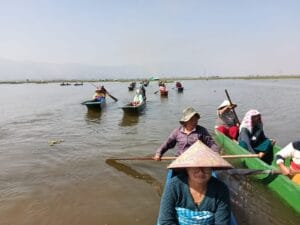
Keeping this background in perspective, the fishing community of Champu Khangpok floating island village had since set themselves to task in contributing meaningfully towards achieving some of the aspects outlined in the CBD GBF targets in their own humble way, howsoever small their efforts might seem to be.
Champu Khangpok marked the observation of World Wetlands Day 2026 earlier this year with a cleanup drive within the lake and along the waterway of Yangoi Achouba (albeit Nambul River), prioritizing the fact that the lake had since become a dumping ground of urban wastes carried by the river along its flow through Imphal city, a fairly populated urbanized zone.
Champu Khangpok villagers also take upon themselves the task of regulating capture fishery to prevent species population decline within the lake and to restrict random capture of fingerlings during the spawning season, and in preventing unethical fishing methods using LED blubs at nighttime and electrocuting fish using batteries.
The fishing community makes it a point to organize important annual events highlighting environmental and ecological concerns, sensitizing locals on the objectives of the GBF targets with prioritization on the long term conservation of the freshwater Loktak Lake and its biological diversity.
Target 3 of the CBD’s GBF focuses on the conservation of 30 percent of the land, waters and the seas globally to protect life on land and in water. Within this target is an important element to recognize the Indigenous and traditional territories.
The Convention recognizes that ‘Indigenous peoples and local communities often own, occupy and manage areas with unique and significant biodiversity. The appropriate recognition of these areas, therefore, could make important contributions in achieving this target’.
This consideration comes with the perspective that the rights of the Indigenous peoples and local communities must be respected fully, including obtaining their free, prior and informed consent in all matters.
The Convention is convinced that the well-governed, effectively managed and representative protected areas, and other effective area-based conservation measures (OECMs), are a proven method for safeguarding both habitats and populations of species and for delivering important ecosystem services and multiple benefits to people.
The CBD has made it a valid point that ‘local people managed protected areas is a central element of biodiversity conservation strategies at the local, national and global levels’.
This consideration of IPLCs’ contribution in safeguarding biodiversity adds strength in achieving the GBF’s Target 4 which focuses on halting species extinction, protecting genetic diversity, and in managing human-wildlife conflicts.
Target 4 specifically ensures urgent management actions ‘to halt human induced extinction of known threatened species and for the recovery and conservation of species, in particular threatened species, and to significantly reduce extinction risk’.
The goal further is ‘to maintain and restore the genetic diversity within and between populations of native, wild and domesticated species to maintain their adaptive potential, including through in-situ and ex-situ conservation and sustainable management practices’.
In the same breadth, Target 6 of the GBF looks at addressing the menace of Invasive Alien Species (IAS) of plants and animals, seeking the reduction of the introduction of IAS by 50 percent globally within a time frame, and, thereto, minimize their impact on the localized biodiversity.
The objective of Target 6 is broadly outlined as: ‘Eliminate, minimize, reduce and or mitigate the impacts of invasive alien species on biodiversity and ecosystem services by identifying and managing pathways of the introduction of alien species, preventing the introduction and establishment of priority IAS, reducing the rates of introduction and establishment of other known or potential IAS by at least 50 percent, by 2030, eradicating or controlling IAS especially in priority sites, such as islands’.
This is one of the priority areas that the Loktak fishers have specifically focused upon in all of these years, highlighting time and again on the menace of aquatic plants, and fish, that are alien to the freshwater Loktak Lake and which are proving as nuisance plants, and fish, within the lake.
Another of the issues faced by the Loktak fishers is the level of pollution within the lake, accentuated by the pollutant loads and sewerage discharge from the urban areas. The Nambul River carries maximum pollutant loads from the urbanized Imphal city areas, a factor for high pollution level in the lake.
This issue is reflected in the GBF’s Target 7 which specifically focuses on reducing pollution to levels that are not harmful to biodiversity.
Target 7 specifies on ‘reducing pollution risks and the negative impact of pollution from all sources, by 2030, to levels that are not harmful to biodiversity and ecosystem functions and services, considering its cumulative effects’.
It further seeks in ‘reducing excess nutrients lost to the environment by at least half including through more efficient nutrient cycling and use; reducing the overall risk from pesticides and highly hazardous chemicals by at least half including through integrated pest management, based on science, taking into account food security and livelihoods; and also preventing, reducing, and working towards eliminating plastic’.
In a nutshell, achieving these targets might be a herculean task for the marginalized fishing community of Loktak Lake, whereas, the zeal to contribute their mite in the smallest possible ways is there for all to see, visible through their continuous activities in their own humble way.
This is where the state and central authorities can step in to aid the Loktak fishers in their march forward – a tiny step taken yet meaningful in saving, protecting and conserving one of India’s most significant inland freshwater lakes – and, that too, a Ramsar site of international importance.