

In climate change dialogues, the significance of wetlands as carbon sinks has multiplied manifold, increasingly with new findings on how much of carbon wetlands can sequester, besides the knowledge on green forests serving as important carbon sinks that absorb excess carbon in the atmosphere to help in climate change mitigation.

By Salam Rajesh
As in the preceding years, the world community observed with solemnity the pledges to save, protect and conserve wetlands on the occasion of the annual World Wetlands Day ritual of social and environmental commitments, howsoever the mission appear far more than practicable to put words on ‘wetlands conservation’ in actuality.
The second day of February every year is dedicated to wetlands as a continued process of the global effort in raising awareness and commitments to saving much of the world’s fast disappearing water bodies of value to humans, wildlife and to nature itself.
An assessment by Hu et al. (2017, as quoted in Anisha, N.F., Mauroner, A., Lovett, G., Neher, A., Servos, M., Minayeva, T., Schutten, H. & Minelli, L. (2020). Locking Carbon in Wetlands: Enhancing Climate Action by Including Wetlands in NDCs. Corvallis, Oregon and Wageningen, The Netherlands: Alliance for Global Water Adaptation and Wetlands International) indicated that the area of wetland loss across the seven continents through the year 2009 and up to present times is considerably large.
Asia continent led the world in wetland area loss by a massive size of 2,646,100 sq km, followed by South America at a close second with a loss of 2,521,900 sq km. Europe figured with a considerably large loss of 972,200 sq km while North America lost 457,100 sq km, Africa 453,500 sq km and Oceania 181,600 sq km respectively.
This massive loss when counted in their totality can be seen to influence negative impacts on the living world, where even the IUCN (International Union for Conservation of Nature and Natural Resources) says that currently near around 47,000 species of animals and plants globally are on the verge of extinction from various reasons including negative anthropogenic influences.
Why would then people in general worry for wetlands dying and disappearing ultimately? The reasons are not far to seek, if people do reconsider the numerous ecosystem services rendered by wetlands in their totality.
For instance, wetlands have strong links to ancient traditions, cultures, spiritual values and religious values that establish socio-cultural links of people to their roots, in particular for wetland dependent or wetland-thriving communities. Manipur has a link in the legacy of the Khamba-Thoibi legends.
While it is generally accepted that wetlands supply food through natural resources such as fish and edible aquatic plants and insects, and through agricultural practices in wetland areas, these water bodies play an important role in climate change resilience and carbon storage. They assist in the regulation of greenhouse gases, temperature, precipitation and other climatic processes.
In climate change dialogues, the significance of wetlands as carbon sinks has multiplied manifold, increasingly with new findings on how much of carbon wetlands can sequester, besides the knowledge on green forests serving as important carbon sinks that absorb excess carbon in the atmosphere to help in climate change mitigation.
Compared to tropical rainforests which were thought of to be the best carbon sinks in the natural world, new findings in this aspect throws light on how wetlands can absorb carbon many times more than tropical forests.
For instance, compared to tropical forests storing 200 tons of carbon dioxide per hectare in soil, peatlands can store a massive 4700 tons of carbon dioxide per hectare in soil. That is a difference by a huge margin.
Similarly, mangroves can store up to 2839 tons of carbon dioxide per hectare in soil, seagrass 500 tons of carbon dioxide per hectare in soil, and salt marsh up to 917 tons of carbon dioxide per hectare in soil, which definitely is quite significant in global discussions on carbon sequestration to meet the deadline on limiting global temperature rise to 1.5 degree Celsius by year 2050.
Tropical forests are estimated to store up to 600 tons of carbon dioxide per hectare in their biomass, whereas, in the same measure mangroves are estimated to store as much as 928 tons of carbon dioxide per hectare in their biomass, which accounts for the global thrust on restoring and regenerating mangroves across most coastal belts around the world.
Wetlands play a major role in assisting with the storage and retention of water which helps flow regulation and provides flood and drought protection, and at the same time, wetlands assist in soil formation through sediment retention and accumulation of organic matter.
These, and much more, are the functional properties of wetlands in general, other than these water bodies providing leisure and fun for people seeking respite from the everyday grinding in life.
As in the preceding years, Manipur was not far behind other communities across the globe in observing the day with fervor and solemnity, urging local communities and the State to devout more time and energy in the larger objective of saving whether water bodies of value are left in the wild within the State.
The State’s Directorate of Environment and Climate Change along with other line departments hosted the day at Yaralpat wetland site in Imphal East District, extolling the importance of wetlands to achieve various ecosystem services including groundwater recharge, fisheries and livelihoods, while providing refuge for wildlife such as the wintering migratory water birds.
The day was also observed widely across the State at academic and civil society platforms, individually and with support from the Directorate.
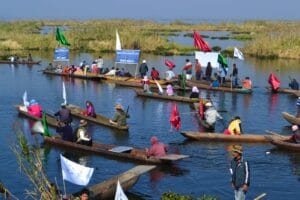
Of significant contribution to the day was the pre-World Wetlands Day 2026 observation on Sunday, 01 February, where the fishing community residing at Champu Khangpok Floating Island Village within Loktak Lake staged a cleanup drive to clear plastics and other domestic wastes along Yangoi Turel Achouba (Nambul River) and its flow up to Birahari Pat within the lake, demonstrating the local community’s responsibility in lake conservation.
Rounding up, it can be well said that a partnership, and workable, model between wetland-dependent local communities and the responsible state agencies can go a long way in shaping the future of wetlands in Manipur, and elsewhere.