
The GWO 2025 report concludes with a harsh note: There is an urgent need to scale up funding for wetlands aligning finance with sustainability by investing in conservation, restoration and wise use, while redirecting harmful subsidies.

By Salam Rajesh
Valuing, conserving, restoring and financing wetlands are no longer optional – it is essential to securing the foundations of life on Earth. This is the opening note of the Global Wetland Outlook (GWO, Special Edition 2025), reminding everyone on the harsh truth of losing wetlands, either from blissful ignorance or the willful defilation of these precious water bodies.
The contradiction is well set when the simple assessment of the two sides of the same coin is placed before the world community: that wetlands provide society with up to 39 trillion US dollars in benefits each year, but the world continues to lose them at a rate of 0.52 percent annually.
Ecosystem benefits provided by wetlands are immense considering from the point of view of how wetlands provide sources of livelihood for thousands of wetland-dependent communities, particularly the fishing community whose only source of earning and livelihood is catching fish, both capture and culture fishery, such as those thriving within Loktak Lake in Manipur.
Wetlands’ ecosystem benefits in terms of carbon sequestration are the centre of deliberation on climate change mitigation measures, where conserving wetlands healthily is considered one of the best options to fight back climate change impacts, contributing to the global target of containing temperature at pre-industrial level.
Wetlands support a diverse range of biological life, including faunal and floral species many of which would be endemic, rare and threatened, and vital to world’s biodiversity. Migratory water birds depend on these water bodies for their feeding ground along their various annual and seasonal migration, escaping the harsh cold of inhospitable landscapes – like Siberia in deep winter.
Thrust areas of the GWO 2025 report hints at integrating restoration efforts across various sectors – agriculture, water infrastructure and urban planning, while prioritizing long-term economic outcomes.
The report is skeptical of the fact that societal, economic, and policy decisions frequently prioritize short term financial returns while neglecting the long-term negative impacts on biodiversity, water quality, food security, and health on account of such un-wise decisions that have the potential to harm wetlands rather than doing good.
Examples are galore across the globe. The ‘un-wise’ decision of the Indian Government to transform parts of the fragile Andaman & Nicobar land(sea)scape into commercial hub looks at the short term gains while neglecting the tremendous impacts on the pristine natural landscape in long term measure.
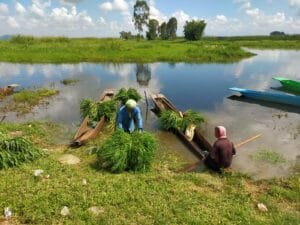
In Manipur, the State’s ‘vision’ of transforming Loktak Ramsar site into fairly commercial tourist hub again looks at the short term economic gain gauged against the possible long term negative impacts on the lake’s ecological and hydrological profile by reasons of the increased human presence and activities, perhaps paving paths for discouraging the migratory water birds from visiting Loktak anymore and seek other feeding grounds.
When this happens, supposedly, how will Loktak stand as a ‘Ramsar’ site, minus the stated population of migratory water birds? Or, would the increased commercial activities dim the traditional lifestyle of the Loktak fishing community? These are questions the State planners have to scrutinize in the minutest of details before saying ‘yes’ to ‘developmental’ projects.
The Global Wetland Outlook 2025 while seeking policymakers, businesses and the society to undertake immediate and coordinated actions to value wetlands, re-engages all stakeholders expressively in dialogues on the ongoing loss and degradation of wetlands that significantly imposes significant costs on governments, economic sectors, and more particularly on wetland-dependent local communities.
Wetlands are evidently losing ground as increased human activities encroach on these water bodies, draining the water to convert parts into farmlands, fish culture ponds, or small commercial enterprises. Physical modification is another damaging factor reducing wetlands into fragmented pieces, either for settlement expansion or for agriculture related activities.
The wetlands report while asserting that the global financing gap for wetlands is immense, stressed that achieving effective conservation and restoration of the world’s wetlands, covering around 550 million ha (to restore at least 123 million ha, and conserve at least 428 million ha), will require significant resource mobilization.
Against this required assessment, the report profiles that the current estimates show that biodiversity conservation funding accounts for just 0.25 percent of the global Gross Domestic Product, highlighting the significant underinvestment in nature, especially wetlands.
The report while calling for embedding wetlands in innovative financial solutions for nature and people, urges that meeting global biodiversity and wetland conservation targets will require innovative financial investments.
Wetlands must be incorporated into financing mechanisms utilizing various financial tools, green and blue bonds, biodiversity credits, results-based financing, and debt-for-nature swaps to achieve leveraging of the necessary funds for wetland protection and restoration, the report noted.
Things, however, are not running smoothly inspite of several global scale negotiations in these past decades, as is evident from the report. The report noted that ‘national reports to COP15 showed that 74% of countries are engaged in wetland restoration to some extent, 66% have national targets in place, and over 70% have identified priority sites. However, progress is uneven, and only a limited number of countries are implementing restoration at sufficient scale or with robust monitoring systems’.
The GWO 2025 report concludes with a harsh note: There is an urgent need to scale up funding for wetlands aligning finance with sustainability by investing in conservation, restoration and wise use, while redirecting harmful subsidies.
It further stressed that without major shifts in financial flows, the goals of the (Ramsar) Convention on Wetlands, the Kunming Montreal-Global Biodiversity Framework, and the Sustainable Development Goals will remain out of reach, perhaps unattainable for years to come and before everything comes to a sad conclusion.
To wrap up, the report is quite specific when it says: The scale of wetland loss and degradation remains a global concern. Wetland decline affects people’s livelihoods and wellbeing, disrupts the climate system, reduces the availability of water resources, increases local communities’ susceptibility to natural disasters, and causes the loss of species and ecosystems.