

Clarifying the Sangh’s concept of “Hindu”, he explained that it is a civilisational identity rather than a purely religious one. “‘Hindu’ is not a noun but an adjective,” he asserted.
TFM Report
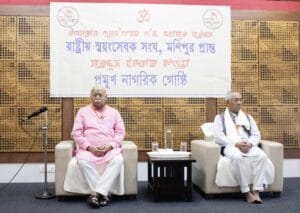
Rashtriya Swayamsevak Sangh (RSS) Sarsanghchalak Dr. Mohan Bhagwat addressed a gathering of dignitaries in Imphal on Wednesday, marking the first major public interaction of his three-day visit to Manipur. During his speech, he emphasized themes of social harmony, civilisational unity, and the patient path to long-term peace.
Dr. Bhagwat began by acknowledging that the RSS is often a subject of national discussion, which is frequently influenced by perceptions and propaganda. He emphasized the unique nature of the organization, stating, “There is no organisation comparable to the RSS, just as the sea, the sky, and the ocean have no comparison.” He explained that the RSS’s growth is organic and that to truly understand it, one must visit a local shakha. He clarified that the objective of the RSS is to organise the entire Hindu society, including those who oppose it, and not to create a power centre.
He noted that misinformation campaigns against the Sangh began as early as the 1930s, even from groups outside India who lacked an understanding of Bharat and its civilisational ethos. Dr. Bhagwat urged people to understand the organization based on truth rather than perception-driven narratives.
Reflecting on the life of RSS founder Dr. K.B. Hedgewar, Dr. Bhagwat highlighted his academic brilliance, patriotism, and contributions to the freedom struggle. He said that Dr. Hedgewar’s realization that a strong, united society was essential for the nation’s progress led to the creation of the RSS. “The Sangh is a man-making methodology,” he said, appealing to the public to understand it through its grassroots shakha tradition.
A significant part of his address was dedicated to clarifying the Sangh’s concept of “Hindu.” He explained that it is a civilisational identity rather than a purely religious one. “‘Hindu’ is not a noun but an adjective,” he asserted. He stated that the strength of a nation depends on unity and societal quality, not merely on leadership. Citing the ancient principle, “Ekam Sat Vipra Bahudha Vadanti” (Truth is One, the Wise Perceive it in Many Ways), he said that truth, compassion, purity, and austerity form the essence of Dharma and reflect the inclusive nature of Hindu civilisation. “Diversity is not a myth. Diversity is the manifestation of inherent unity,” he added.
Dr. Bhagwat discussed India’s ancient nationhood, explaining that the idea of Bharat emerged not through Western-style state formation but through the spiritual pursuit, or “tapasya,” of ancient seers for the welfare of humanity. He noted that concepts such as Vasudhaiva Kutumbakam (the world is one family) encapsulate the universal vision of Hindutva.
Stressing the importance of social strength, he remarked, “Nobody listens to the weak. As our societal strength increases, the world listens to us.” He explained that the mission of the Sangh is to nurture capable individuals for a strong and harmonious Hindu society, reiterating that the Sangh does not work for its own glory.
He outlined the five key initiatives, or Panch Parivartan, of the RSS centenary year: promoting Social Harmony, Family Awakening, Environmental Protection, understanding our identity and promoting swadeshi, and fulfilling our Civic Responsibility.
Commending Manipur’s strong cultural traditions, including the use of native attire and local languages, Dr. Bhagwat encouraged communities to preserve and strengthen these practices.
Addressing the current situation in Manipur directly, he stated that efforts are underway at both community and societal levels to restore normalcy. He called for patience, noting that “Destruction takes minutes, but construction requires years—especially when done inclusively and without harming anyone.” He stressed that peace-building requires collective effort and societal discipline.
Dr. Bhagwat also emphasized that people should not expect everything from the government, noting that societal awareness and self-reliance are essential for a self-reliant India, or ‘Swavalambi Bharat’. He added that skill development is vital for building an economically empowered society.
He concluded by reiterating the Sangh’s long-standing ideal: “Sampoorna Samaj ka Sangathan by Sajjan Shakti,” which means the organisation of the entire society through the power of the virtuous. The session concluded with an interaction with participants on issues related to youth, reservation, and capacity-building.