

The nemesis of Loktak Pat is primarily referred to Ithai Barrage, a man-made structure designed to store water for generating hydro electricity for the 105 megawatt capacity Loktak Hydroelectric Power Project – a ‘green energy’ project has had faced countless criticism since the day it was commissioned in mid 1983.

By Salam Rajesh
In these past few years there has had been quite a few reports spilling around on the imminent man-made disaster with one of India’s important inland freshwater wetlands – the Loktak Lake of Manipur, a significant Ramsar site of international importance.
From the perspective of water bodies that are reservoirs of diverse biological lives, Loktak is relatively significant when viewed from the bird’s eye scan of being located within two very important biodiversity hotspots in the world, namely, the Eastern Himalaya Biodiversity Hotspot and the Indo-Burma Biodiversity Hotspot.
Again, from the perspective of two very significant international flyways passing through the North East India region, covering Manipur with Loktak as an important stopway for transboundary migrating water birds from as far as the Far East Asia, it is of utmost concern, locally and globally, that Loktak is suffering from ailments that could possibly reduce it to naught.
Thousands of different species of water birds, and other avian species, flock to Loktak Lake every winter, starting October and leaving by around February. This population of winter visitor birds is vital in sustaining Loktak Pat as a Ramsar site of certain importance.
The issue at hand is manifold, including the concern on whether Loktak will continue to support and sustain these diverse biological lives in the coming years. For one thing, scientists studying the ecological process of this wetland had repeatedly referred to it as an ‘aging’ wetland, meaning its countdown to a ‘dead’ lake had begun.
The nemesis of Loktak Pat is primarily referred to Ithai Barrage, a man-made structure designed to store water for generating hydro electricity for the 105 megawatt capacity Loktak Hydroelectric Power Project – a ‘green energy’ project has had faced countless criticism since the day it was commissioned in mid 1983.
Besides losing thousands of hectares of prime agricultural land, and large displacement of human population, when a constant water level at 768.5 meters above the mean sea level was maintained for the hydro project, it subsequently impacted the ecology of the wetland drastically, which perhaps the hydro project designers did not foresaw.
In recent years, one very concerning aspect in relation to the aging process of Loktak is the evident ecological and hydrological degradation of Nambul River, a water way which traverse through the highly populated Imphal urban city and which is singularly the most important river to deposit directly into the lake.
Nambul River deposits whatever it carries along its flow directly into Loktak, meaning whatever pollutant loads and sewerage discharge it carries are deposited without check directly into Loktak, thereby becoming a factor for enriching the nutrient contain in the lake. This, of course, is what scientists are talking about the process of eutrophication in the lake.
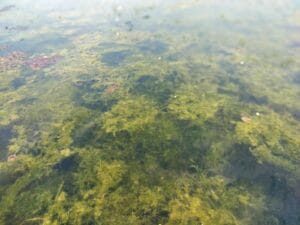
Last week, Nambul River stretch from Meino Thong Bridge up to Maharani Bridge point was the scene of algal bloom turning the river water greenish, untidy, and unhygienic for all purposes.
Before that, at least three months back, mud plush from Lamphelpat through Shamushang-uku point turned the river water highly turbid – muddy by all definition. The people working on the Lamphelpat rejuvenation project had intentionally released the mud waste from Lamphelpat directly onto Nambul River.
This, of course, can mean one thing only. Anthropogenic activity for all negative reasons had helped the aging process of both Nambul and Loktak. Whatever problems are seen in Nambul River is naturally applicable to Loktak Lake. If Nambul is carrying domestic wastes, it means Loktak will be receiving the wastes. If Nambul is suffering algal bloom, it could mean parts of Loktak will be having a similar issue. It is as simple as that.
In the midst of all the deliberations on the physical health of both Nambul and Loktak, people are forgetting another pervasive issue, and that is the health status of Naga River, a small but significant contributing river which equally carries pollutant loads and sewerage discharge directly into Nambul River, and thence onto to deposit in Loktak. The chain cycle is vicious.
A newspaper quote of a paper (Loktak Lake: A System at Risk) published by researchers Yumnam Roma Devi and Potshangbam Kumar Singh of the Manipur International University (03 January, 2026) refers to the water quality condition of Nambul and Nambol rivers containing high levels of nitrates and nitrites where some measurements exceeded the WHO’s safety level of 50 milligrams per litre for drinking water.
The paper further refers to the nutrient enrichment leading to ‘eutrophication and triggering algal blooms that deplete oxygen and harm aquatic biodiversity’. The past few days have seen widespread algal bloom along the stretch of Nambul River between Sagolband and Uripok in central Imphal.
Other than this worry on chemical residues, and runoffs, aided by untreated sewerage discharge from the households in urban Imphal areas flowing into Nambul River and further on to Loktak Lake, the biggest worry is on the physical modification of parts of the lake, reclamation, and conversion of water body to land structure for fish culture ponds, playgrounds, extension of settlements, and small-time businesses.
The process of continued deposit of silt load from the feeder streams into the lake and the depth of the lake becoming shallower year after year is hastening the rapid degradation of the lake.
Topping this is the entry of invasive alien species of aquatic and semi-aquatic plants, spreading almost like wildfire, covering up the original growth of native plants and reducing the open water body area substantially. The spread of paragrass, water hyacinth, water lettuce and alligator weed is entirely changing the ecological profile of Loktak.
In sum, in the absence of effective management strategy of the lake, starting from failing to treat the rivers Naga Turel, Nambul Turel and Nambol Turel efficiently, Loktak Lake is at high risk of undergoing phenomenal physical and ecological changes that could render the lake into a condition of a ‘wasteland’ – a water body that is unhygienic, unusable, and a source for water-borne diseases.
Leaving Loktak as it is in its present condition could only hasten the early death of this vital water body which provides life to humans, and the plant and animal world. Manipur would be poorer by one significant wetland in the longer term, while the Indo-Burma Biodiversity Hotspot region would be losing a critical asset.
(Salam Rajesh is an Imphal based media professional, and currently works as an independent researcher and writer on socio-environmental issues.)