

Imphal’s streets reveal how convenience and social hesitation undermine the fight against single-use plastics, reflecting a deeper environmental crisis unfolding across Manipur.

By Salam Rajesh
The vegetable vendor on the street in uptown Imphal said off-handedly, “It seems the early morning walkers are shy to carry cloth bags for shopping”. As simple as it sounds, her reflection drew a parallel to the oft-repeat discourse on the use or misuse of plastics in Imphal, in Manipur, in India, and across the world.
The woman’s sundry observation is on the scores of early morning joggers and walkers who while returning from their walk purchase vegetables contained in thin plastic carry bags, much against the Government’s ban on the use of the one-time-use disposable plastic carry bags.
For that matter, this writer did see vendors smiling on seeing the cloth carry bag that he had in his hand, shooing away the thin plastic carry bag in which they had put in the purchased vegetable.
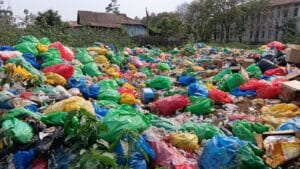
Plastics are by-products of chemicals’ marriage with natural greens, ingrained in a process that has ultimately wrapped the globe in a Catch-22 situation, either you use it or you don’t use it as your whim fits.
Either way, plastics are in the thick of heated debates all over the world for the problems it is causing on both the human and the natural environments.
Come to think of it, why should the early morning walkers in urban Imphal be shy to carry a cloth bag for shopping? Go back four to five decades down memory lane, and it was a common sight to see almost everyone carrying cloth bags on their shopping spree. There was nothing to be shy of to carry a cloth shopping bag.
Today, every available space on land and water are being chocked by plastics, ranging from the discarded toothbrush to carry bags, bottles, slippers, household utilities, containers, electronic items, and much more.
The drains, sewerages, ponds, streams, rivers, lake – all are stacked to the brim with plastic items thrown randomly, recklessly by unmindful individuals.
For Manipur, as in many parts of the globe, the worst part of the story is that people studying the scenario are reporting that fish caught from Loktak Lake, for instance, and so maybe from its associated rivers, are containing microplastics in their bodies. That sounds awful, and dangerous to human health in the long-term.
Microplastics, as like nanoplastics, are the breakdown of tiny pieces of plastic from a bigger plastic item like the one-time-use water bottle or that thin carry bag, perhaps disintegrated by weathering process.
The U.S. National Oceanic and Atmospheric Administration (NOAA) and the European Chemicals Agency (ECA) describe microplastics as fragments of any type of plastic less than 5mm (0.20 in) in length.
Again, the US EPA researchers define microplastics, or MPs, as plastic particles ranging in size from 5 millimeters, which is about the size of a pencil eraser, to 1 nanometer (nm).
The study of microplastics contained in animal flesh or other body parts is increasingly being linked to human health concerns, such as the likely connection to cancer.
The more concerning matter is, what was this talk all about banning of certain items of consumer plastic goods? For all we know, there are plastics everywhere – the shops, the vendors, the buyers, the morning walkers, where almost everyone demonstrates their adherence to plastics, and more plastics.
So, as the average person would ask, what happened to the ban on the use of certain items of plastics? There was some effort at seizures by the enforcing agencies, imposing fine, but ultimately everything was back to square one. People buy, sell, and use banned plastic items under the very nose of the enforcement agencies. That’s it.
It then comes down to the discussion on where the administration is failing in its commitment to erase the plastic menace once and for all times. The basic question would be, is there actually a foolproof strategy to check, filter and halt the use or misuse of banned plastic items in Manipur, and elsewhere? What about the plastics manufacturers and wholesalers – who controls them?
Last year, there was a report in the journal Earth.com where a research team led by Dr. Emilio Gómez‑Sánchez of the Next Fertility Murcia in Spain found that tiny bits of plastic no wider than a human hair had penetrated the human bloodstream.
Their data presented at a meeting of the European Society of Human Reproduction and Embryology indicated that the tiny plastic bits had breached the fluids that surround the human eggs and had traveled with the sperm.
Yet again, another report in the journal Nature Medicine last year unearthed an alarming study that looked at microplastics contained in the human brains, as scary as it sounds.
Article 1 of the Global Plastics Treaty emphasizes on ending plastic pollution, with countries around the world advocating for a comprehensive approach addressing the entire life cycle of plastics from its production to disposal.
Countries deliberated on the need to end plastic pollution and divergent perspectives on the framing and ambition of this objective. Most countries agreed that the treaty should explicitly aim to protect human health and the environment, with many emphasizing the need for a comprehensive, full life-cycle approach to plastics.
To limit microplastic consumption, the general suggestion is to reduce people’s use of single-use plastics, avoid heating food in plastic, and to filter tap water. The suggestion filters down to the use of reusable bags, bottles, and containers, and choosing cloth shopping bags, bamboo cutlery, and metal water bottles.
The suggestion is also to avoid plastic straws, bottles, cutlery, and canned food with plastic liners. Other ways to reduce microplastic consumption is to buy organic clothes, avoiding plastic-containing cosmetics, and reducing consumption of processed foods.
What’s the worry about? As NOAA and ECA would explain, these tiny plastic particles can directly damage cells by causing physical disruption, disrupting cell membranes, and inducing cell death (apoptosis).
Microplastics and nanoplastics can trigger oxidative stress within the body by generating harmful free radicals, leading to cellular damage and potential disease development. At the same time, the presence of these particles can trigger an inflammatory response in the body, potentially contributing to chronic inflammatory diseases.
The agencies say that due to their small size, nanoplastics can readily penetrate tissue barriers and accumulate in various organs, including the liver, lungs, and reproductive organs, leading to the disruption of organ function.
Depending on the organ affected, accumulation of microplastics and nanoplastics can disrupt normal physiological processes, leading to potential organ dysfunction, warns NOAA and ECA.
So, watch out for these miniscule hidden dangers that can potentially ruin healthy human bodies – your body. Say ‘No’ to the one-time-use plastic items, especially those banned ones.