

Many children in Manipur today may grow up without any knowledge of Khongjom Parva, since it is not included in the formal school curriculum, and even their parents often possess only a vague awareness of it.
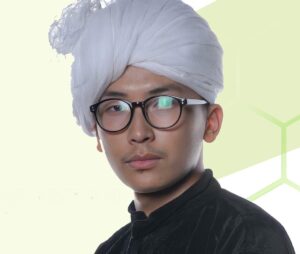
By Marjing Mayanglambam
The continuity of Khongjom Parva depends on cultivating a new generation of listeners, learners, and connoisseurs who will not only appreciate the art form aesthetically but also embrace it as a living expression of Meitei identity and cultural heritage.
Khongjom Parva has two variations: Ningthourol and Kangleirol. Ningthourol narrates the brave warriors of the erstwhile Kingdom of Manipur who sacrificed their lives for their motherland, choosing death over subjugation by outsiders. This performing art is based on the Anglo-Manipur War of 1891, which took place in Khongjom. Kangleirol, on the other hand, encompasses myths and legends from the land of Moirang, including the epic of Khamba Thoibi and other tales of reincarnation.
Trained under Guru Thanga Mangoljao, Oja Sundari has cultivated her own distinctive Khongjom Parva Seishak, blending her Guru’s teachings with influences from other masters. This creative reworking of inherited traditions exemplifies Richard Bauman’s idea that folklore survives through innovation and performance, rather than static repetition. Similarly, Bruno Nettl has argued that musical traditions endure precisely because they adapt to changing cultural needs—a principle clearly embodied in Oja Sundari’s style.
Her Seishak may be understood as an evolutionary cultural trait shaped by the demands of time and shifting audience sensibilities. Clifford Geertz reminds us that culture should be seen not as an inert force, but as the context within which practices acquire meaning. Oja Sundari’s artistry thus represents a negotiation between the weight of history and the pressures of the present, illustrating what Henry Glassie describes as creating the future out of the past.
Equally important is the role of the audience in determining the survivability and vitality of her style. Alan Dundes emphasized that folklore continues to exist because communities need it, value it, and actively sustain it. The reception of Oja Sundari’s performances reflects this principle, as the endurance of her Seishak depends not only on her individual creativity but also on the community’s desire to preserve and celebrate it. Victor Turner further argued that performance is a form of social action; in this case, Oja Sundari’s Khongjom Parva becomes both an artistic expression and a site where Meitei cultural identity is reaffirmed, negotiated, and transformed.
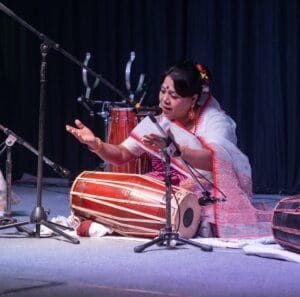
Unsurprisingly, many children today may grow up without any knowledge of Khongjom Parva, since it is not included in the formal school curriculum, and even their parents often possess only a vague awareness of it. This absence reflects what Richard Bauman noted about tradition: that it persists only when actively transmitted and performed across generations. In the contemporary context, where global musical influences dominate everyday life, the organic transmission of such forms has become increasingly fragile. Yet, if a child encounters the songs of Khongjom Parva and feels inspired to know more, learning may begin through curiosity and familial persuasion. Alan Dundes stressed that folklore survives not through institutional imposition but because communities value it and choose to sustain it. Thus, the continuity of Khongjom Parva today depends less on formal structures and more on individual moments of discovery and affective engagement. However, as Bruno Nettl observes, musical traditions survive by adapting to modernity, and unless such forms are creatively reimagined to capture youthful attention, their practice may remain rare within the globalised soundscape.
Oja Sundari continues to work tirelessly to transmit Khongjom Parva to her disciples, students at the Manipur University of Culture, and other committed supporters. Once a vibrant art form deeply embedded in Meitei households, Khongjom Parva later expanded into public performances at ceremonies, festivals, and community gatherings. Its present decline illustrates John Blacking’s observation that music as a cultural practice is sustained only so long as it remains socially meaningful and integrated into daily life. Today, as one of Manipur’s endangered traditions, Khongjom Parva faces the fragility identified in UNESCO’s framework for Intangible Cultural Heritage—the vulnerability of oral traditions, performing arts, and communal practices when intergenerational transmission weakens.
For Oja Khumanthem Sundari, a pioneering practitioner of both major variations of Khongjom Parva, this decline is especially painful. She has dedicated her life to reviving the art her own Gurus once safeguarded from near extinction. Her efforts resonate with Richard Bauman’s notion that performance is not passive replication but an active reworking of cultural memory, and with Henry Glassie’s view of tradition as the creative construction of the future from the past. Yet, despite the commitment of individual bearers, the UNESCO ICH convention reminds us that safeguarding cannot rely solely on practitioners; it requires active recognition, support, and participation from the wider community. The continuity of Khongjom Parva, therefore, depends on cultivating a new generation of listeners, learners, and connoisseurs who will not only appreciate the art form aesthetically but also embrace it as a living expression of Meitei identity and cultural heritage.
(Marjing Mayanglambam is currently pursuing M.A. Folklore & Culture Studies. He is also a Pena Artiste & Researcher, Laihui Ensemble)