

A special report on the cryosphere by the Intergovernmental Panel on Climate Change (IPCC) indicated that changing snowfall and rainfall patterns due to climate change have made the Himalayan mountains quite vulnerable. Glacier retreat and permafrost thaw have decreased the stability of mountain slopes and the integrity of infrastructure, the IPCC report noted.

By Salam Rajesh
The extensive dialogues on climate change and global warming implications have reached a stage where the reality is becoming too harsh to be ignored that easily anymore, so much so as the recent Dharali disaster had revealed the ugly truth.
India’s Himalayan states have been bearing the brunt of rising temperatures, and extreme weather events with the beginning of Southwest Monsoon 2025, with two successive cloudbursts in Uttarakhand being the most recent one.
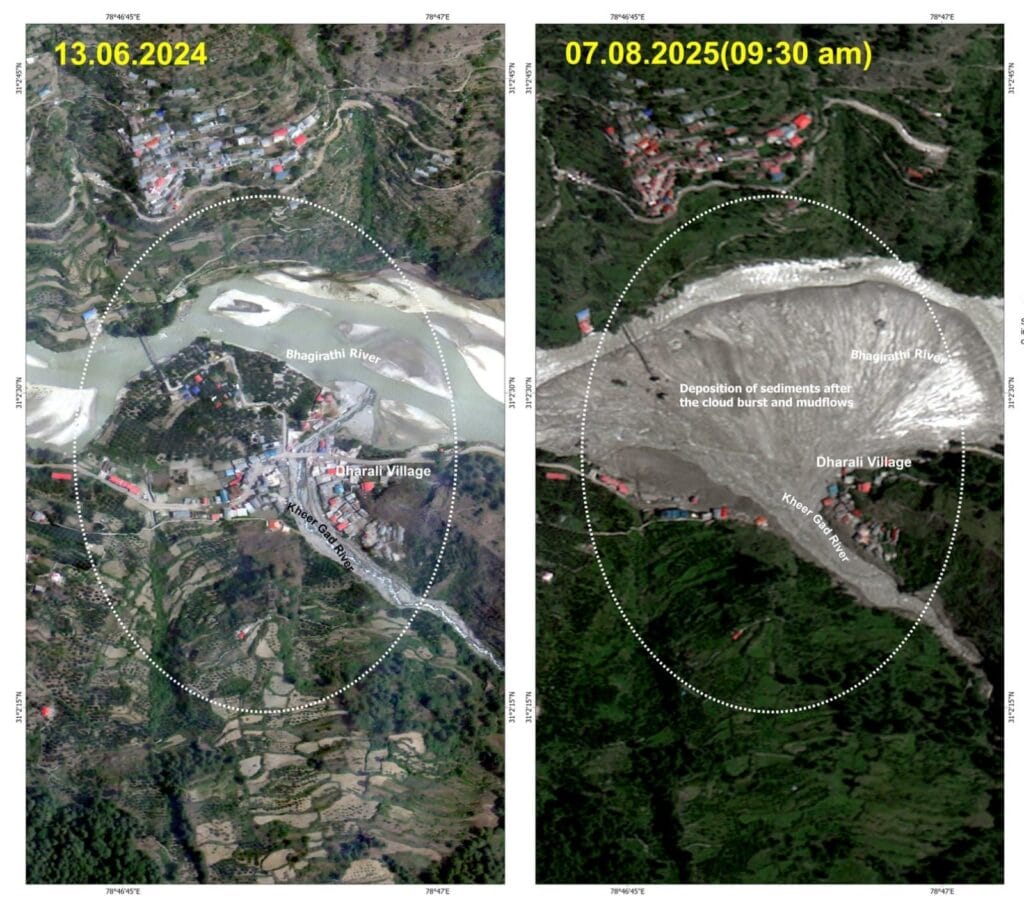
On the afternoon of the fifth day earlier this month, giant streams of water came down gushing through the streets of Dharali village in Uttarkashi District, crumbling infrastructure and burying people along its destructive path.
The climate watch group, Climate Trends, assessed that the imprints of the three planetary crises, and shifting monsoon patterns, had resulted in rising temperatures and humidity as key contributors to more frequent and intense weather events in the Hindu Kush Himalaya Region.
These factors infused abnormal ocean warming leading to increased moisture in the atmosphere, resulting in more intense and frequent cloudbursts, or similar conditions. A shift in the monsoon pattern, driven by the Middle East spring heating, is pushing south-westerly winds northward, intensifying rainfall over northwest India and the Himalayas, according to Climate Trends.
Global temperature rise with each succeeding year is accelerating glacier melt in the Himalayas, causing glacial lakes to fill rapidly and increasing flood risk, while glacier thinning is destabilizing mountain slopes, increasing the likelihood of deep-seated landslides with the potential to create havoc downhill.
The climate watch group stated that a recent study ‘Increase in occurrence of large glacier‑related landslides in the high mountains of Asia’ recorded 127 large glacier-related landslides during the period from 1999 to 2018 across the Karakoram, Pamirs, Western Himalayas, and the Hindu Kush Himalaya.
Noting that rainfall extremes in high-elevation areas are amplified by a 15 percent per degree of warming, that is, double of what atmospheric theory predicts, Climate Trends urged the authorities for taking up different precautionary measures such as early warning systems, floodplain zoning, mapping of danger zones, community evacuation plans and adaptation infrastructure amongst others.
The Dharali disaster has once again exposed the truth that unplanned development in the fragile Himalaya landscape has influenced vulnerability to infrastructural projects like roads, tunnels, hydropower, tourist spots and hotels in the ecologically fragile zones, thus aggravating high risks.
The lack of regulation and monitoring in the critical Himalayan setting, despite the stark warnings from the 2013 Kedarnath and the 2021 Rishiganga disasters, continues to threaten communities, Climate Trends noted.
Skymet Weather’s meteorology and climate change expert Mahesh Palawat observed that, “With the axis of the monsoon trough running through the foothills of the Himalayas, we had already predicted a red alert for Uttarakhand. While the affected region is prone to cloudbursts, such a turn of events is due to the climate change-led rise in temperatures. A huge influx of moisture from the abnormal warming of oceans increases the capacity of the air to hold more water vapour”.
While the Karakoram glaciers show relatively stable conditions with minimal retreat, the data on glacier retreat for the years 2023 up to 2025 indicated that the Hindu Kush Himalayan glaciers are retreating at an average rate of 14.9 ± 15.1 meters per year.
Meantime, a special report on the cryosphere by the Intergovernmental Panel on Climate Change (IPCC) indicated that changing snowfall and rainfall patterns due to climate change have made the Himalayan mountains quite vulnerable. Glacier retreat and permafrost thaw have decreased the stability of mountain slopes and the integrity of infrastructure, the IPCC report noted.
Referring to this, climate scientist Dr Raghu Murtugudde says that, “The rapid warming over the Middle East and the Mediterranean is a signature of global warming. This regional warming has been pulling the southwestern winds northward over the Arabian Sea. There is excess moisture being pumped into the Himalayan foothills. Because of this northward shift of the south-westerly winds, heavy rainfall events could take place in Himachal Pradesh and Ladakh before the season is over”.
Experts have already warned against the more intense rainfall bringing a greater risk of landslides in high-elevation regions, demanding the development of specific mitigation and adaptation plans at a faster pace. Due to climate change, hazards, such as glacier retreat, permafrost degradation and lake shrinkage, occur frequently in high altitude regions, often leading to slope instability and an increase in the occurrence of deep-seated landslides, Climate Trends noted.
Dr Subimal Ghosh of the Interdisciplinary Program in Climate Studies, IIT Mumbai, noted that with the per degree centigrade warming, the extreme precipitation increases by seven to eight percent, and this is what is being witnessed at present. With climate change, extreme weather events are increasing and will continue to rise in the coming years, he said.
Professor YP Sundriyal of Doon University, Uttarakhand, agrees that the role of global warming is already established in the rise of extreme weather events. People did not learn anything from the past disasters in 2013 (Kedarnath) and 2021 (Rishiganga). Concerned authorities and local bodies should include scientists while carrying out any construction in the region, as they are well-versed in the geology, he emphasized.
Prof Anjal Prakash of the Bharti Institute of Public Policy, while sharing his views noted that, “Such devastating events in Uttarkashi and other hilly regions highlight the increasing frequency of cloudbursts and flash floods driven by climate change. Unfortunately, India is not doing enough to develop climate-resilient infrastructure that can withstand these extreme weather events”.
“To safeguard communities and manage natural resources better, it is crucial to invest in adaptive infrastructure and establish more monitoring stations in the Himalayas and their upper reaches. Enhanced surveillance and early warning systems are vital in addressing the increasing frequency of extreme weather events like cloudbursts and flash floods”, Prof Anjal says.
He further noted that, “Without immediate action, these disasters will only become more frequent and severe, risking lives, homes, and livelihoods. Automatic Weather Stations (AWS) play a vital role by providing real-time data from the Himalayas, especially in their upper reaches. This information helps authorities issue timely alerts, enabling communities to prepare and evacuate in advance, thus saving lives and reducing damage. Given the rising intensity of climate-induced disasters, India must expand its network of AWS and invest in advanced forecasting technology to build a more resilient and prepared society”.