

The nightmare for those who are striving to safeguard the mammal is the question on what will be the future of the Sangai and its habitat in the very near future, given the context that the habitat is degrading fast enough.

By Salam Rajesh
At the turn of the new seasonal year 2026 it has become imperative to re-understand the present status of one of the rarest mammals that Manipur proudly calls its own, despite the numerous threats to the animal in question.
The Manipur Brow-antlered Deer (Rucervus eldii eldii McClelland, 1842), locally and universally popular as “Sangai” – the deer that looks back, finds itself listed among the several mammals in the world on the verge of extinction if proper attention and care is not given for the protection and in-situ conservation of this rarest of the rare animal (sub) species in the world.
The IUCN (International Union for the Conservation of Nature and Natural Resources) maintains a long list of animals, birds, fishes, reptiles, insects, plants and trees that are at certain point of disappearing altogether from this earthly world owing to several reasons of which human interference is foremost.
The IUCN’s Red Data Book is a warning to nations that unless and until effective measures are taken up immediately and in long-term measures, their precious natural assets would be lost forever. This includes Manipur’s State Animal – Sangai, too.
Listed in Schedule-I of the Indian Wild Life (Protection) Act, 1972, since amended many times, and in Appendix-I of CITES, it is accepted generally that the Manipur Brow-antlered Deer, a sub-species of the cervid Eld’s Deer, along with its cousins in Myanmar and Thailand, is highly threatened in its only refuge in the wild at Keibul Lamjao National Park.
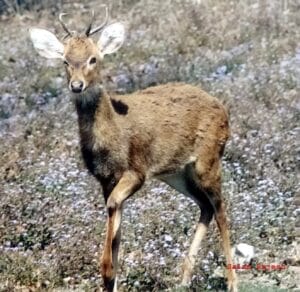
The Park, since protected from 1977 onwards in a small area of only 40 square kilometers with an affordable habitat in just a miniscule 15 sq km area – its core area – the Sangai along with other inhabitants like the Hog Deer (Axis porcinus) and the Wild Boar (Sus scrofa), is observed as struggling to survive in a habitat that is largely fragmented and plagued with different ailments.
The introduction of the man-made structure Ithai Barrage – an important component of the 105 megawatt capacity Loktak Hydro Electric Power Project – since mid 1983 had entirely changed the hydrological and ecological profile of the national park, including the entire water spread of the freshwater Loktak Lake.
The regulation of water flow of the Manipur River and the Khuga River by the barrage had led to a situation of permanent stagnation of the water within the Loktak wetland complex. This is interpreted as a constant water level maintained by the barrage at 768.5 metres above the mean sea level at all times, in whatever season.
At this dynamics, it has been seen that the change in the natural cycle of the hydrology of the Loktak wetland complex had led to distinct negative impacts on the national park. In the absence of the seasonal life-cycle of the biomass ‘Phumdi’ within the park, much part of the biomass spread are observed becoming thinner with each passing year.
On the ground, this concept had been proven correct to some measure when this writer and colleagues went in to study the habitat at ground zero, trekking in within the core area to understand the dynamics at first hand.
In 1996, on a first visit it was observed that a patch of the biomass could easily support the weight of a person weighing at least around 60 kilo. Later in the 2000s, on further visits it was experienced that much of the biomass could not support the weight of a person in the same measurement.
The result, understandably, was that the person(s) standing on the biomass patch had to move very fast from one patch to the other, otherwise the person would be sinking up to waist deep as the biomass patch cannot support the human body weight.
In this simple analysis, non-scientific as it is but a practicable demonstration, it was assumed that a Sangai deer weighing at least 40 kilo would equally be experiencing a sinking feeling if it does not move fast from one biomass patch to the other.
This allows for the reason of several reports of the mammal dying by drowning within the core area of the park. The other reason for its death is the unrelenting poaching by hunters taking advantage of the porous ‘unfenced border’ of the park and the weak strength of the park’s forest guards.
It was with these concerns on the predicament of Manipur’s state animal that the Chingmei-based Society for Sangai and Nature Conservation (SSNC) organized a two-day workshop and awareness campaign (10-11 January) on the protection of Manipur’s highly respected and awed mammal.
The workshop, supported by the BRIC-Institute of Bioresources and Sustainable Development (IBSD), Department of Biotechnology (Government of India), and the Wildlife Institute of India, in hand with the State Forest Department and the Directorate of Environment and Climate Change, drew critical observations from the attendees, particularly the local inhabitants.
One very fundamental question that cropped up during the workshop’s interactions was the issue on the missing link between Forest Department and the local population on a shared partnership in co-management of the Protected Area – a critical issue that since has been circulating in the several Conference of Parties (COP) of the several bodies under the United nations.
In terms of Keibul Lamjao National Park, the long standing issue has been the ‘respect’ of the rights and privileges of the local community as and when the PA was conceptualized and implemented. This had transliterated to a situation of ‘conflict of interest’ between park managers and the local people.
The important deliberation that emerges today is on how to design a co-partnership between the park managers and the local people in safeguarding the habitat of the wildlife within KLNP and in resolving the several issues on the core theme of saving the Sangai and its habitat.
The nightmare for those who are striving to safeguard the mammal is the question on what will be the future of the Sangai and its habitat in the very near future, given the context that the habitat is degrading fast enough.
The sum of the dialogue was that the State administration needs to act fast in designing a foolproof strategy to save one of nature’s precious asset and a living testimony of Manipur’s contribution to the natural world.
The threat of losing the Sangai altogether is too evident, and Manipur and the world cannot afford to lose this precious asset of nature.
(Salam Rajesh is a prominent environmental activist, senior journalist, and conservationist based in Imphal, Manipur)