

The increasing frequency and intensity of such events pose a significant risk to the livelihoods of people across the globe, according to a study (Global Climate Highlights 2024) published by Copernicus Climate Change Service and ECMWF earlier this year

By Salam Rajesh
Climate extremes are almost a by-word today, integral to the disasters that have rocked human population, and nature, furiously in contemporary times, causing untold misery and despair as nature’s fury ravages land, forests, mountain rivers, human settlements, roads and other infrastructures.
The year 2025 has had its share of the climate extremes, ranging from steep temperature climb, devastating wildfires in Europe and in the United States, howling cyclones and hurricanes in Europe and Asia-Pacific region, and to cloudbursts and glacial lake outburst floods in the Himalayan region. None are being spared, literally.
To reminiscence the foregoing year 2024, extreme weather events were observed worldwide last year, ranging from severe storms and floods to lethal heat waves, droughts and wildfires. Year 2024 broke records as the warmest year in a century, overshadowing year 2023 which earlier held the title of warmest year in a time scale of 174 years.
The increasing frequency and intensity of such events pose a significant risk to the livelihoods of people across the globe, according to a study (Global Climate Highlights 2024) published by Copernicus Climate Change Service and ECMWF earlier this year.
The study noted that the total amount of water vapour in the atmosphere reached a record high in 2024, at about 5% above the 1991-2020 average, and significantly higher than in 2023. This abundant supply of moisture amplified the potential for extreme rainfall events, it said.
Additionally, combined with high sea surface temperatures, the high moisture contained contributed to the development of major storms, including tropical cyclones, the study noted.
The study emphasized that high temperatures can lead to situations where the body is under stress from overheating, while other environmental factors such as humidity can also impact heat stress.
Last year, much of the globe experienced more days than average with at least ‘strong heat stress’ with some regions experiencing days that had average with ‘extreme heat stress’, at which level it is imperative to take action to avoid heat stroke, the study noted.
Prolonged dry periods in several regions created conditions conducive to wildfires, amplified by large-scale and persistent wildfires that were recorded across the Americas. In terms of wildfire carbon emissions, Bolivia and Venezuela recorded their highest levels on record, it said.
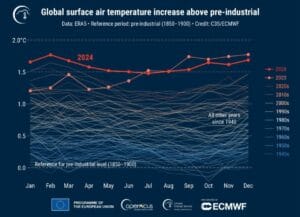
The study explained that high sea surface temperatures (SSTs) was one of the most significant drivers behind the prevalence of high global temperatures during 2023 and 2024, of which one of the primary factor was the evolution of the El Niño Southern Oscillation (ENSO) which peaked in December 2023 and continued to influence global temperatures in the first half of 2024.
August 2024 was as warm as August 2023, and the other months from July to December ranked as the second warmest on record, behind 2023, while notably 22nd July marked the hottest day ever recorded, with global temperature reaching 17.16°C, according to ERA5.
Year 2024 became the first year to register an annual temperature anomaly exceeding the 1.5°C threshold above the pre-industrial level. The two-year average for 2023 and 2024 exceeded this threshold, the study noted.
Laurence Rouil, Director of CAMS at ECMWF noted that the report showed the critical value of ECMWF’s monitoring activities, where in 2024 the atmospheric GHG reached the highest annual levels ever recorded in the atmosphere, according to C3S and CAMS data.
Carbon dioxide concentrations in 2024 were 2.9 ppm higher than in 2023 and methane concentrations were 3 ppb higher, Rouil emphasized, stressing that this increase brought the annual estimate of the atmospheric concentration of carbon dioxide to 422 ppm, and of methane to 1897 ppb.
Extreme temperatures and high humidity contributed to the increased levels of heat stress where much of the Northern Hemisphere experienced more days than average with at least ‘strong heat stress’ last year, and some areas saw more days than average with ‘extreme heat stress’.
In 2024, the area of the globe affected by at least ‘strong heat stress’ reached a new record annual maximum on 10 July, when around 44% of the globe was affected by ‘strong’ to ‘extreme heat stress’, the study noted indicating that this was 5% more of the globe compared to the average annual maximum.
The atmospheric concentrations of carbon dioxide and methane continued to increase and reached record annual levels in 2024, at 422 parts per million (ppm) and 1897 parts per billion (ppb) respectively, the study stated, while the carbon dioxide concentration last year was 2.9 ppm higher than in 2023, whereas methane concentrations were 3 ppb higher.
Meanwhile, a study published in Nature Climate Change in March earlier this year noted that the world experienced a 240 percent increase in the average number of marine heat wave (MHW) days during the summers of 2023 and 2024.
The MHW days, which are extreme rises in ocean temperature for an extended period of time, hit every part of the globe, the study noted stressing that close to 10 percent of the oceans experienced the highest sea surface temperatures (SST) ever, four times higher than the historical annual average.
Copernicus is a component of the European Union’s space program, and is coordinated and managed by the European Commission and implemented in partnership with the European Space Agency (ESA), the European Organization for the Exploitation of Meteorological Satellites (EUMETSAT), the European Centre for Medium-Range Weather Forecasts (ECMWF), European Union Agencies and Mercator Ocean.
ECMWF is an independent intergovernmental organization supported by 35 States, and the supercomputer facility at ECMWF is one of the largest of its type in Europe.