
Akoijam described the PUCL document as “a deplorable display of irresponsibility with dangerous implications for peace and harmony.” He ruled out legal action against the report’s authors but demanded accountability.
TFM Desk
Congress MP Angomcha Bimol Akoijam (Inner Manipur) has come out swinging against the People’s Union for Civil Liberties (PUCL) report on the Manipur conflict, branding it “irresponsible, dangerous, and an embodiment of racist orientalism.”
In a sharply worded social media post, Akoijam said he was anguished that reputed jurists, scholars, and civil rights defenders could produce such a “partisan” document that, instead of clarifying facts, “adds fuel to an unprecedented human tragedy.”
MP Tears Into Report’s Premise
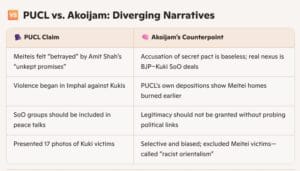
The PUCL report claims that sections of the Meitei community feel “betrayed” by Union Home Minister Amit Shah for failing to keep “promises.” But Akoijam asked bluntly: “What promises? What betrayal?”
He argued that the report insinuates that Meiteis—as a “primarily Hindu majority”—had a secret understanding with the BJP to unleash violence against “Christian minority tribals,” with Kukis only “retaliating.”
“This is a reckless conflation of the Meitei community with the BJP and Hindutva,” Akoijam said, reminding that Kuki ministers were part of the Biren Singh government and there were BJP Kuki Members of the Manipur Legislative Assembly.
Instead, he flipped the allegation, questioning why PUCL ignored mounting evidence of the BJP’s linkages with Kuki armed groups under the Suspension of Operations (SoO).
Questions BJP-SoO Nexus
Akoijam pointed to documented instances—including cases before the High Court—of the BJP government transferring crores of rupees to SoO groups before elections.
“Was this money not linked to an understanding that, once BJP won, it would take care of their demand for separate administration?” he asked.
He said investigators should have vigorously probed whether the Centre’s inaction against armed groups, even as violence spiraled, stemmed from this electoral nexus and the BJP’s “divide-and-rule politics.” “Instead of investigating these forces, the report simply frames one community as perpetrator and another as victim,” he said.
Stakeholder Legitimacy for Armed Groups?
The PUCL report further recommends that peace talks include SoO groups to lend “legitimacy” to the process.
Akoijam questioned the rationale: “What role have these groups played in the current crisis that they should be accorded legitimacy as stakeholders?” He argued that if PUCL was serious, it should have also examined the ties between political parties and Kuki armed groups, instead of focusing disproportionately on alleged Meitei linkages.
‘Retaliatory Violence’ Claim Rejected
The MP strongly rejected PUCL’s framing that mobs first attacked Kuki settlements in Imphal, followed by “retaliatory” violence in Churachandpur and Kangpokpi.
“This is a distortion of facts,” he said. “Even PUCL’s own testimonies mention Meitei houses being burned in border villages before the Imphal violence. Yet the report concludes the opposite.”
Akoijam called this “sheer hypocrisy” — condemning the authors for preaching against “victim–perpetrator binaries” while simultaneously entrenching them in the narrative.
Calls Out Orientalist Bias
Akoijam’s sharpest criticism was reserved for PUCL’s decision to include graphic photos of dead Kuki victims—17 in total, including a decapitated body—while excluding those of Meitei victims. “This bias is deeply troubling,” he said, calling it a continuation of “racist orientalism.” He drew parallels with Western media practices, where images of dead white bodies are avoided, but those of Africans and Asians are freely displayed.
“The northeast has been the ‘other,’ whose dead bodies can be displayed without compunction. Indian scholars who condemn Western practices are now guilty of the same double standards,” Akoijam said. He warned that publishing such images was not only insensitive but also risked perpetuating hatred and prolonging the cycle of violence.
Demands Apology, Report Withdrawal
Summing up, Akoijam described the PUCL document as “a deplorable display of irresponsibility with dangerous implications for peace and harmony.” He ruled out legal action against the report’s authors but demanded accountability.
“PUCL must demonstrate fortitude and self-respect by withdrawing the report and tendering an unconditional apology to the people of this country,” he said, adding that he would publish a detailed rebuttal soon.